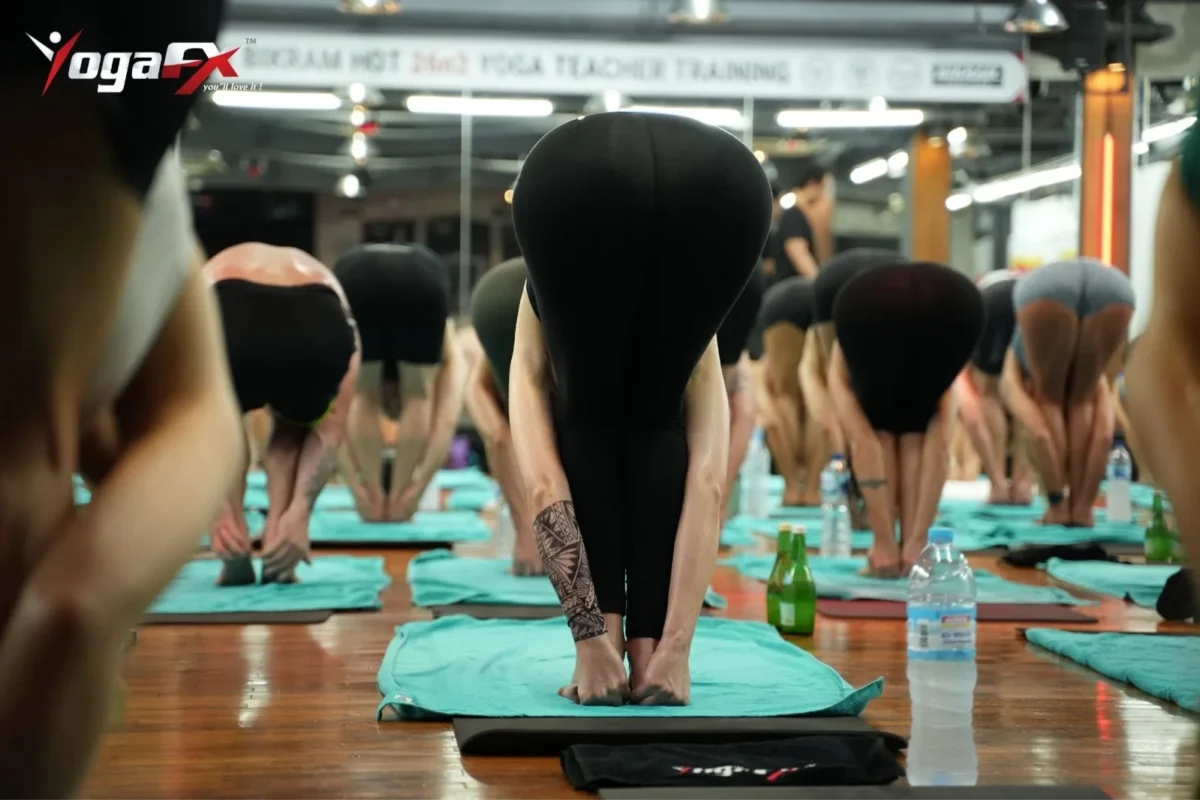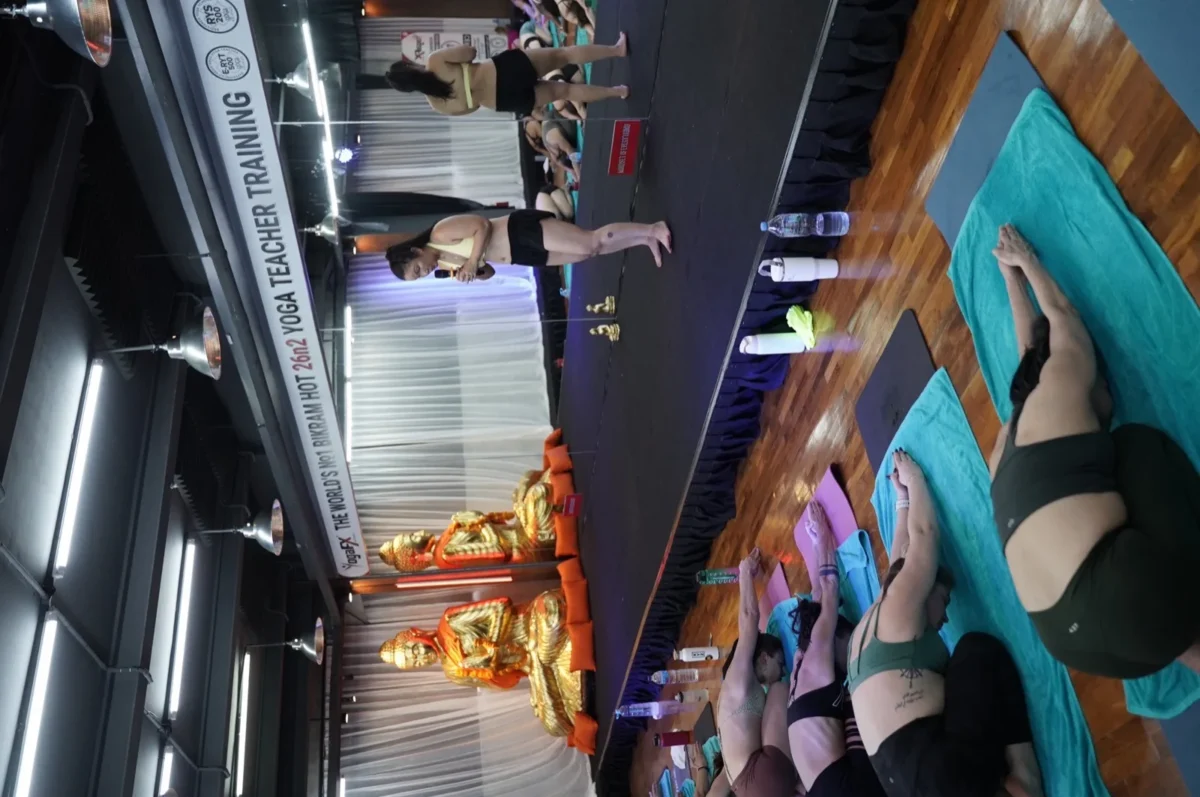
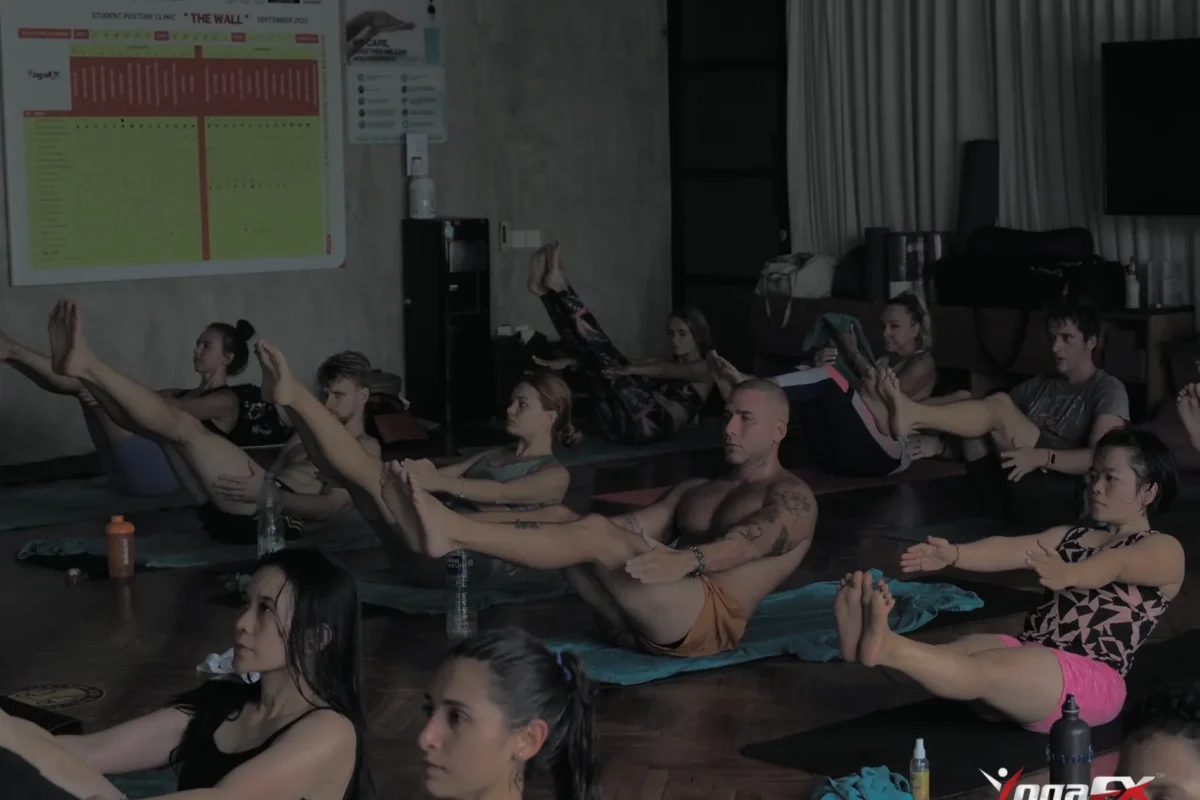
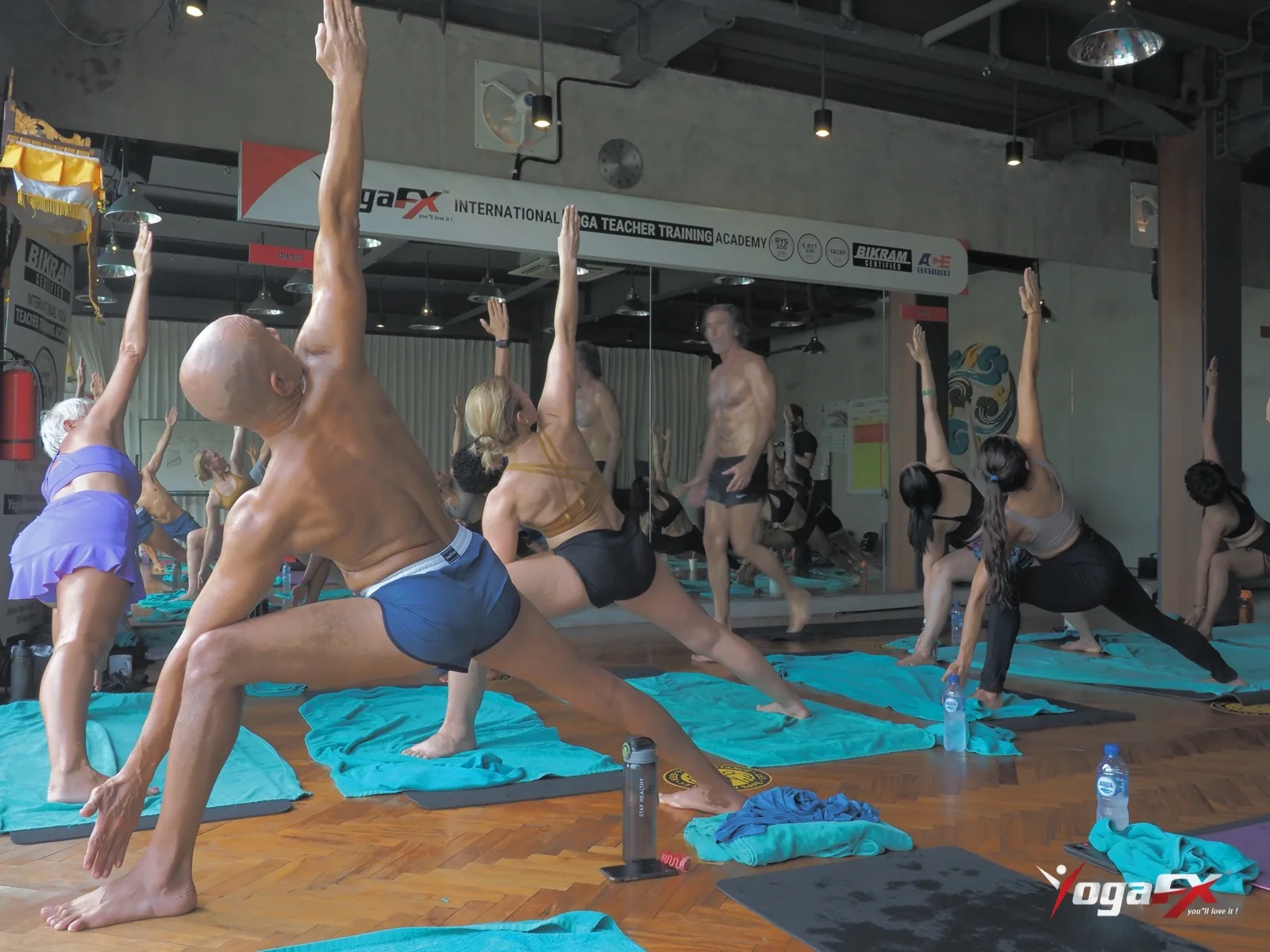
Triangle pose (Trikonasana) is a wide-legged standing posture where you bend the front knee, send the hips back and reach long through a straight top arm. For UK beginners, the hard part is not the stretch. It is holding that knee bend while the studio sits at 40°C.

This guide walks a first-timer through the shape, the cues in plain English, the mistakes we see most often and what a realistic first month looks like. It is written for people in Britain who are curious about a hot class and want to arrive prepared.
Triangle pose is the ninth of 26 postures in the Hot 26&2 series, taught by Mr. Ian Terry (E-RYT 500, 12,000+ teaching hours) at YogaFX. If you want the full cue-by-cue walk-through from the method’s own home, the 26 and 2 team has written a separate triangle pose guide. This page stays with the first-timer’s questions.
Triangle Pose for UK Beginners: What You Are Asked to Do
Think of triangle pose as three jobs at once. Your legs make a wide base, your torso stays long and tilted, and your arms line up like the top of a mast. None of the three can rest while the others work.
In a hot studio, the order of the cues matters more than depth. A beginner who sets the feet properly and bends the knee by a sensible amount will get more from the pose than someone who copies the deepest shape in the mirror.
Here is the short version of what the pose asks for:
- A wide stance with the front foot turned out and the back foot almost straight ahead.
- A deep front knee bend held over the ankle, while the back leg stays strong and straight.
- Hips sent back so the chest can open towards the ceiling instead of folding down.
- A long top arm reaching past the ear, with the gaze turned up only as far as the neck allows.
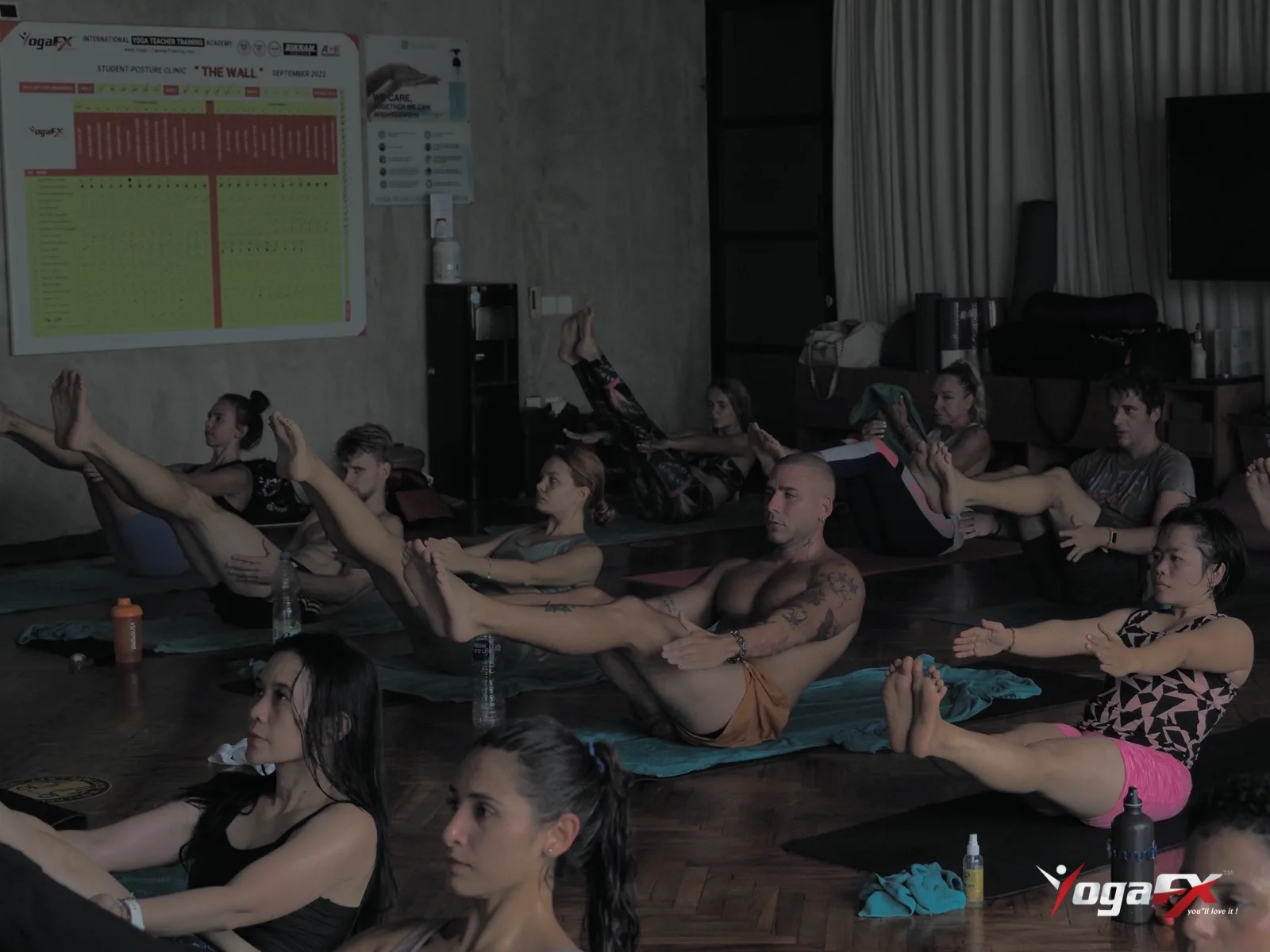
You will not hear the full dialogue written out here, because it is taught live. In class, always follow your teacher. If you also want to see where triangle pose sits in the whole class, our guide to the Hot 26 posture class in the UK shows the order.
Triangle Pose Cues in Plain English, With the Usual Slip for Each
Every cue in triangle pose fixes the one before it. The stance lets the knee bend, the knee bend lets the hips move back, and the hips let the chest open. Pull one out and the whole shape wobbles, so it helps to know what each cue is for and how it tends to go wrong in a British body.
| Cue | What it is for | Typical slip for UK beginners | First fix to try |
|---|---|---|---|
| Wide stance | Gives the front knee room to bend over the ankle | Feet too close, often from sitting at a desk all week | Take one more small step out, then check the knee sits above the ankle |
| Front foot turned out | Lines the knee and hip up the same way | Foot points forward while the knee turns out | Rotate the whole front leg from the hip, not only the foot |
| Deep front knee bend | Builds strength in the front thigh and glute | Knee caves inward, or the bend stays very shallow | Aim the knee at the little toe and shorten the bend if it caves |
| Straight back leg | Anchors the inner back thigh stretch | Back knee locked hard, or soft without noticing | Press the outer edge of the back foot into the floor |
| Hips sent back | Keeps the spine long and the chest open | Hips drift forward and the chest rounds down | Picture the hips sliding away from the front knee |
| Top arm past the ear | Lengthens the whole side of the body | Arm drops forward or the shoulder shrugs up | Reach the fingertips away while the shoulder stays soft |
One small point about names: the sequence lists this posture as Trikanasana, while many books spell it Trikonasana. Both describe the same three-sided shape, so do not worry about which one you see.
Notice that the slips are rarely about flexibility. They are about setup. That is good news, because a setup problem is fixed by attention, not by years of stretching.
For a wider view of which postures suit tight desk hips and gym shoulders, see our guide to hot yoga poses for men. Triangle pose is one of the postures that gets mentioned most.
7 Common Triangle Pose Mistakes and How to Fix Them
Most triangle pose mistakes appear in the first thirty seconds, when a beginner rushes the lean. Here are the seven we see most often in class, with the first thing to try.
1. Front knee falling inward
The foot turns out but the knee does not follow, so the joint twists. Aim the knee at the little toe and keep it stacked above the ankle. If it still caves, shorten the bend.
2. Chest dropping towards the floor
Hips that creep forward drag the ribs down with them. Fix the hips first, then lift the chest. Your spine should feel like one long line, not a curve.
3. Back leg collapsing
A straight leg still has to work. Press the outer edge of the back foot into the floor and wake up the thigh. If the back of the knee feels jammed, soften a touch.
4. Cranking the neck
Looking up is extra depth, not a test. Go only as far as your neck stays comfortable. If the neck complains, keep the gaze level and still reach the arm.
5. Holding the breath
Clenching the breath clenches the body. Lengthen each exhale and let the shoulders melt away from the ears. Noisy breathing is fine; no breathing is not.
6. Chasing depth in the heat
Warm air makes muscles feel looser than they are. A hot class can tempt you to go further than you would in a cold gym. Judge the pose by how it feels, not how it looks in the mirror.
7. Skipping the second set
Each posture in the series is repeated, so you get two goes on each side. Some beginners treat the second set as a breather. Use it instead to change one cue and notice the difference.
If you have tight hamstrings, you may find the pose after it harder. Our guide to standing head to knee pose for tight UK hamstrings covers the next posture in the series.
Why Triangle Pose Feels Like Zone 3 to 4 in a Hot Room
How hard is it, really?
Zones are simply slices of your maximum heart rate, and many people estimate that maximum as 220 minus their age. We place triangle pose in Zone 3 to 4, roughly 70 to 90% of that maximum. Treat it as our working estimate for this posture, because nobody has measured the pose on its own.
Several things stack up here: a deep knee bend, a long hold and steady breathing in a warm room. The big leg muscles do the work, while the heat makes your heart beat faster to help you cool down.
What the research says about effort
For a sense of the whole class, a 2014 University of Wisconsin study (Porcari et al.) measured a standard 90-minute hot class at about 333 kcal for women and 460 kcal for men. That figure covers the full class, not triangle pose alone.
The NHS offers a simple way to judge effort. It says you are working at a moderate intensity if you can still talk, but not sing. Its guidelines for adults suggest at least 150 minutes of moderate intensity activity a week. A hot class is one way to build towards that. Our full class is more than one posture, of course.
Warm Muscles, Tension Not Pain: Staying Safe in Triangle Pose
Heat is helpful and risky at the same time. The Mayo Clinic says you may hurt yourself if you stretch cold muscles, and that you should stretch in a smooth movement without bouncing. It also says to expect tension while stretching, not pain: if it hurts, you have pushed too far.
That advice fits triangle pose well, because it comes late in the standing series, after a long stretch of full-body work. The muscles are warm, which is helpful. But warmth can also hide how far you are pushing, so slow down.
Here are the checks we suggest for UK newcomers before a first class:
- Tell your teacher about any knee, hip, back or neck problem before class starts.
- Speak to a GP or other healthcare professional first if you have heart problems, high or low blood pressure, or you are pregnant.
- Come hydrated and bring water, because you will sweat in a 40°C room.
- Step back at once if you feel sharp joint pain, dizzy or sick, and rest on your mat.
The NHS says it is common to sometimes feel dizzy, lightheaded or off-balance, and it is not usually serious, and to see a GP if you are worried. That is general information, not medical advice. If dizziness keeps coming back, get it checked. For more on safety, read is hot yoga safe.
Your First Four Weeks With Triangle Pose
Before the plan, a few UK-friendly basics make the first class easier:
- Bring two towels, one for the mat and one for your face and hands.
- Wear shorts or fitted leggings so you can see your knee in the mirror.
- Eat lightly a couple of hours before, rather than arriving hungry or full.
- Arrive early so you can settle and take in the room before class starts.
Nobody masters triangle pose in one class. A sensible plan is to change one thing at a time, and to treat the first weeks as practice in setup, not depth. The table below is a gentle guide, not a promise.
| Week | Focus | What you might notice | Effort tip |
|---|---|---|---|
| 1 | Learn the stance and foot placement | Front thigh burns early; hold feels long | Keep the knee bend shallow and stay in the room |
| 2 | Hips back, chest open | Chest starts to turn up instead of down | Use the mirror to check hips, not just the arm |
| 3 | Top arm and gaze | Shoulder and side body feel longer | Look up only as far as the neck allows |
| 4 | Use both sets | The second set feels steadier than the first | Change one cue between sets, no more |
Many beginners find a hot class easier to start in the colder UK months, when stepping out of the studio is a big contrast. But there is no wrong season, and a steady rhythm of a few classes a week matters more than any single session.
What Students Say About Learning With Mr. Ian
Mr. Ian Terry has taught more than 12,000 hours, and graduates have come from 80+ countries. We do not quote numbers to sell; we quote them so you know the people behind the cues. Here are three short reviews from students, from our Google and YouTube reviews.
“It was amazing Yoga practice, my body feel change and it is the best training for you who want to be yoga teacher.”
Reva, Google review, 2019
“Mr Ian, I think it’s really gifted to meet you in my life.”
A trainee in our YouTube review, 2023
“I get a lot of experience and a lot of changements.”
A trainee in our YouTube review, 2023
You can watch one of these student reviews from the YogaFX channel below.

From Triangle Pose to Teaching: A Bali Option for UK Students
Some students start with one posture and end up wanting to teach. If that is you, the YogaFX Bali hybrid course is built for UK applicants who cannot take weeks off work: you study online first, then complete an intensive of about six days in Bali.
It leads to Yoga Alliance RYT 200-Hour and the Bikram Hot 26&2 200-Hour International Yoga Certification. Read original hot yoga teacher training for UK students for costs, travel and time off.
Want to feel triangle pose before you decide? The Seminyak studio in Bali offers a Free 1-Day Guest Pass, so your first class is free. Message Mr. Ian and the team on WhatsApp to plan a visit.
FAQ
What muscles does triangle pose work?
Triangle pose works the front thigh and glute through the deep knee bend. It stretches the inner back thigh, the hamstring of the straight leg and the side of the body. The top arm and shoulder also work to stay long and lifted.
Is triangle pose different from extended side angle?
In many classes the front leg stays straight in triangle pose and bends in extended side angle. In the 26 and 2 series, the front knee bends deeply, so triangle pose looks closer to a side angle. Ask your teacher which version your class uses.
How do I modify triangle pose with tight hamstrings or hips?
Narrow the stance a little and keep the front knee bend shallow. Keep the spine long instead of reaching for the floor. Tell your teacher before class about any sore knee or hip, so they can adjust the shape while you follow the cues in order.
How often should a UK beginner practise triangle pose?
Triangle pose is taught in every class of the Hot 26&2 series, so a few classes a week gives regular practice. The NHS suggests at least 150 minutes of moderate activity a week for adults. Start gently, rest when needed and build up slowly.
Is triangle pose safe for everyone in a hot room?
Not everyone should start without advice. Speak to a GP first if you have heart problems, blood pressure concerns, or you are pregnant. Tell your teacher about knee, hip, back or neck problems. Stop and rest if you feel dizzy, sick or sharp pain.
Still have questions? Message Mr. Ian and the YogaFX team on WhatsApp and we will answer them personally.