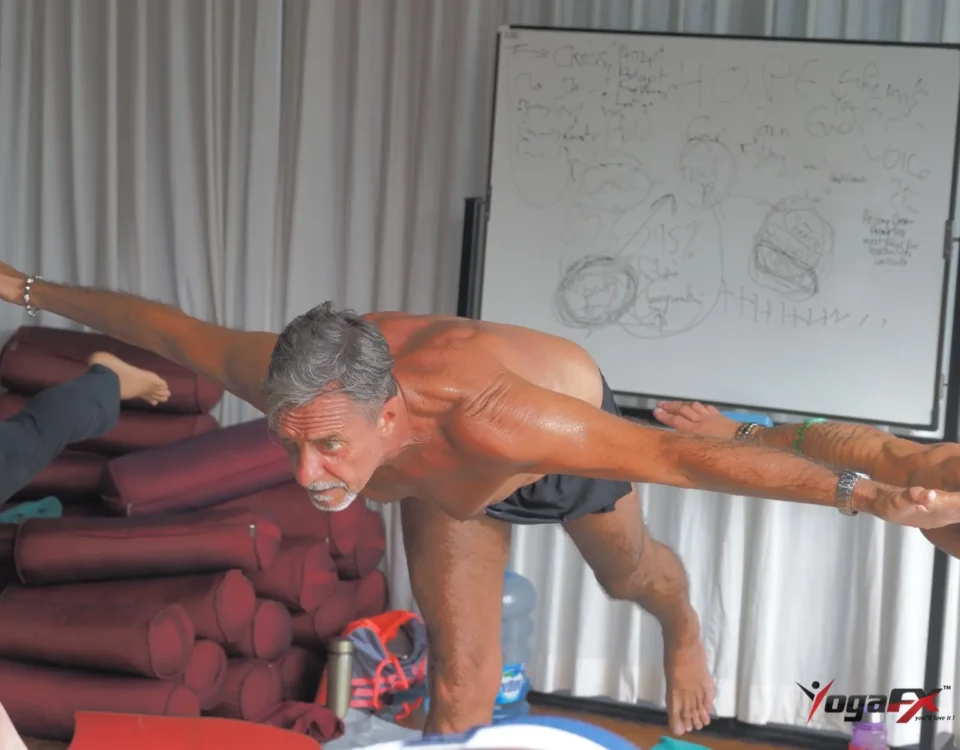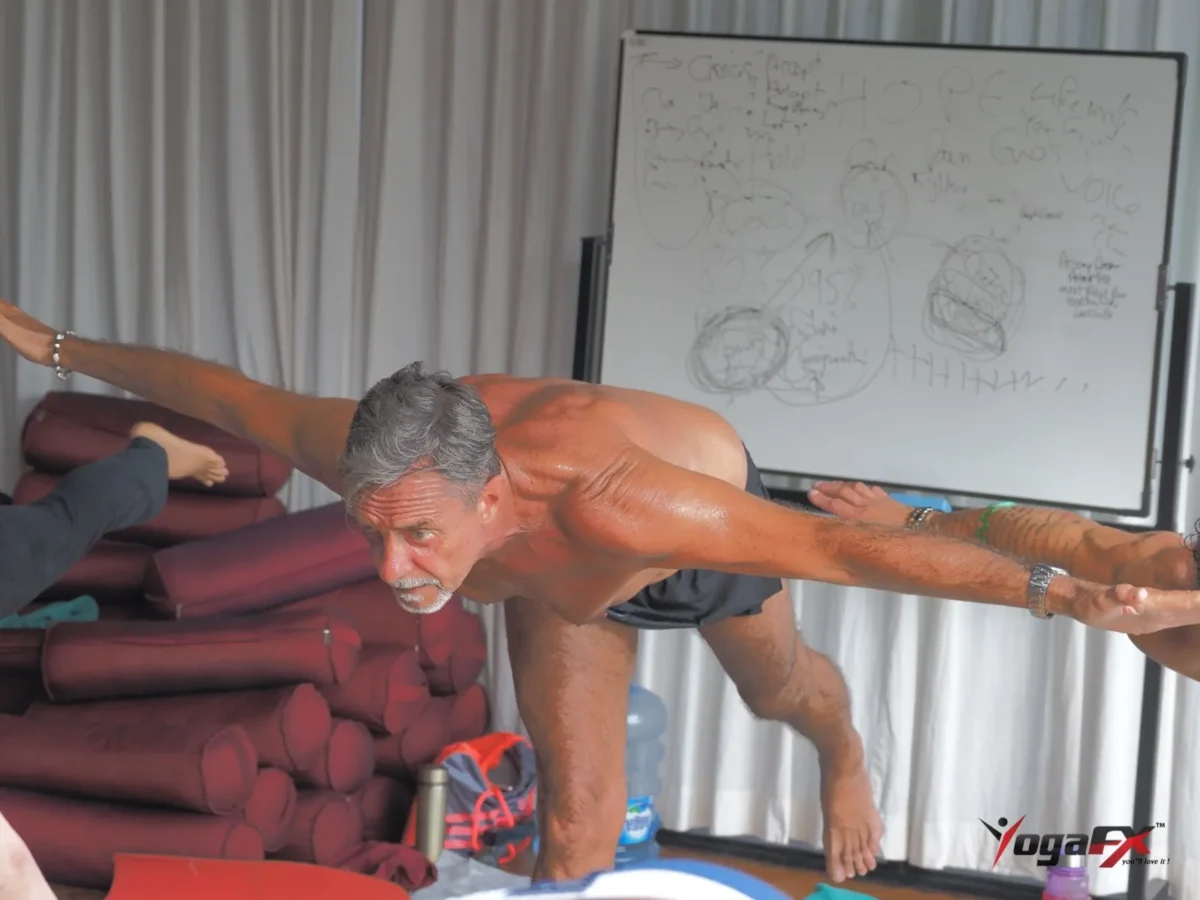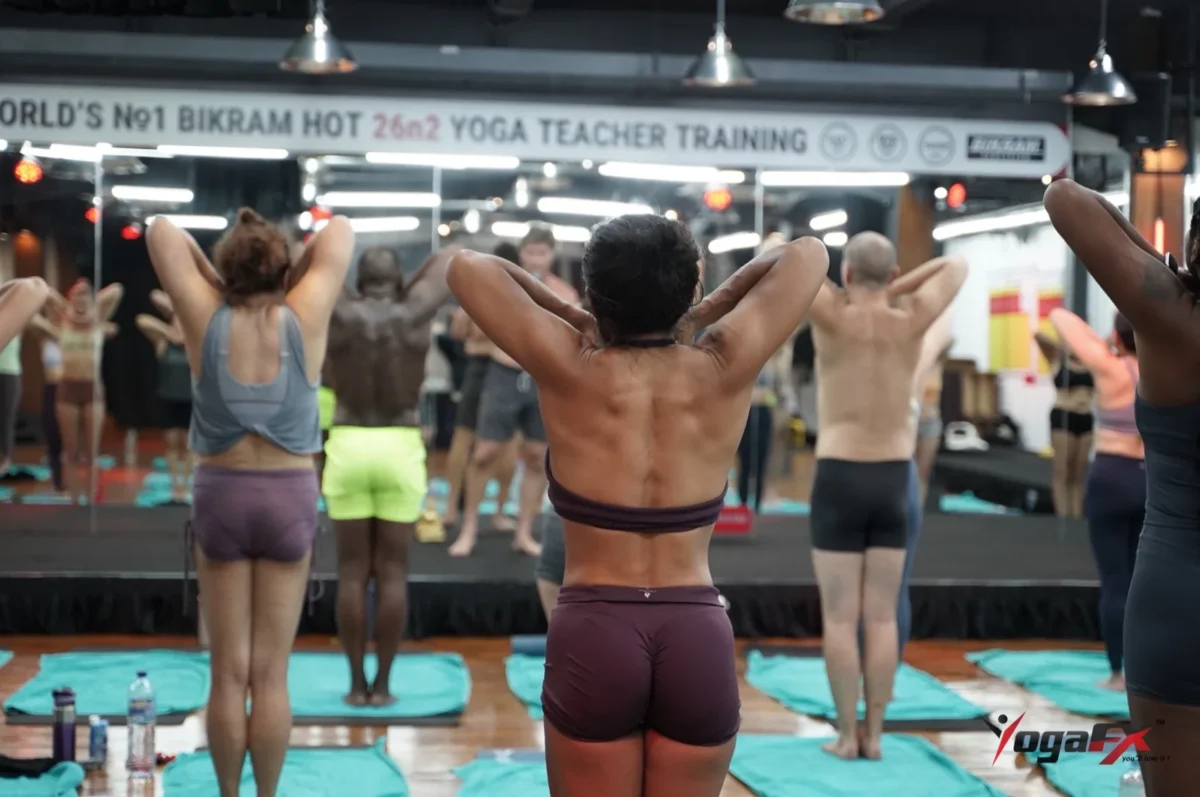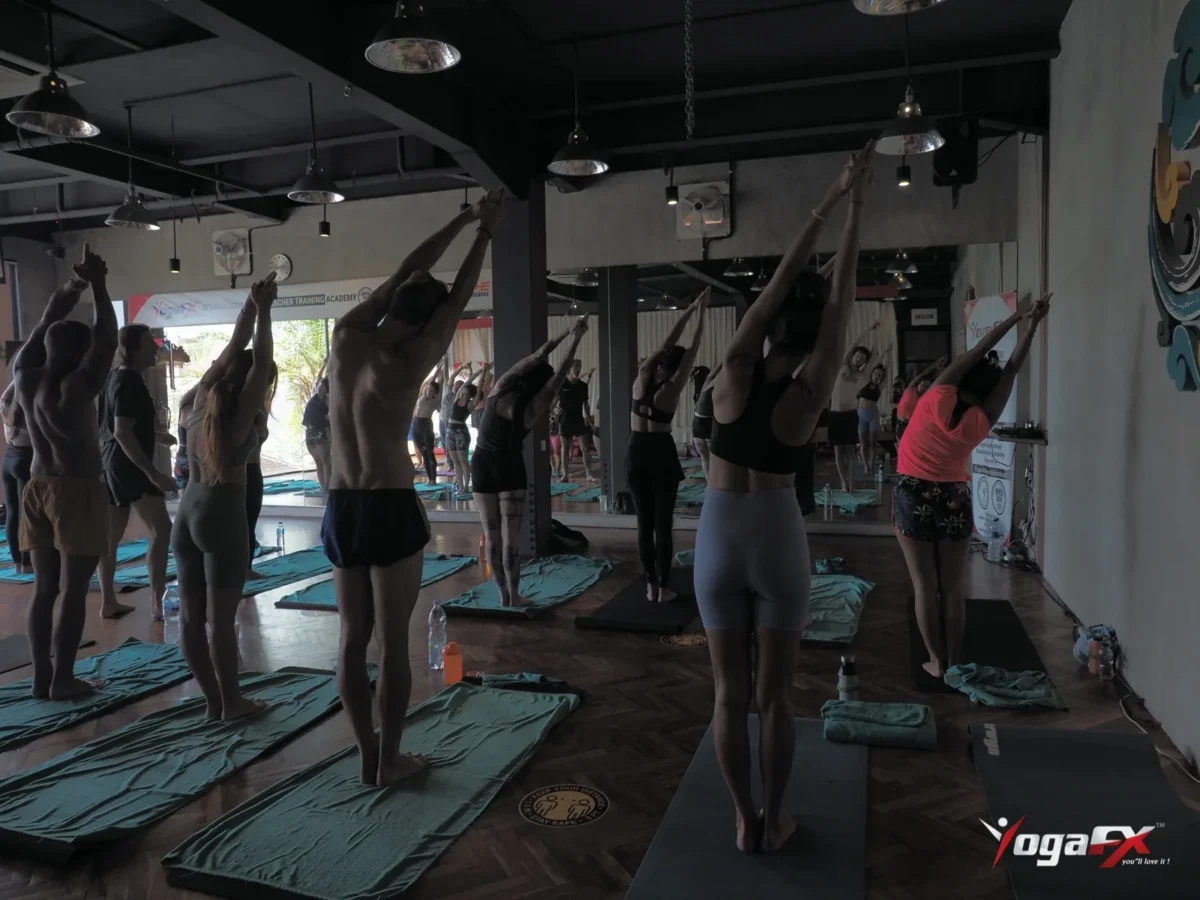
Balancing stick pose (Tuladandasana) is the Hot 26&2 standing posture where you balance on one leg, reach both arms forward and tip into a level T-shape. For UK students the aim is simple: a firm standing foot, hips kept square, and one steady line from fingertips to toes, even when the room is 40°C.

Balancing Stick Pose in a UK Hot Room: The Short Answer
Most British students meet balancing stick pose after a few weeks in a hot room, usually on a damp evening after work. The posture is quick, so a wobble shows up fast. Don’t worry if yours does. The fix is nearly always in the first beat, the standing foot, rather than the lifted leg.
Here’s the order we teach at YogaFX, and it never changes:
- Root. Stand tall on one leg, spread the whole foot and keep the knee strong.
- Reach. Lift both arms beside the ears with the hands together.
- Hinge. Tip forward from the hip as one piece, not from the waist.
- Line. Send the back leg straight behind you until arms, torso and leg form one level line.
- Return. Rise slowly, reset the base, then repeat on the other side.
If you want the full student walkthrough in plain language, the original guide to Tuladandasana and the seven steps sits on our sister site. This page is different. It is written for UK students who wobble, and for anyone who wants to understand why.
Why UK Students Wobble in Balancing Stick Pose
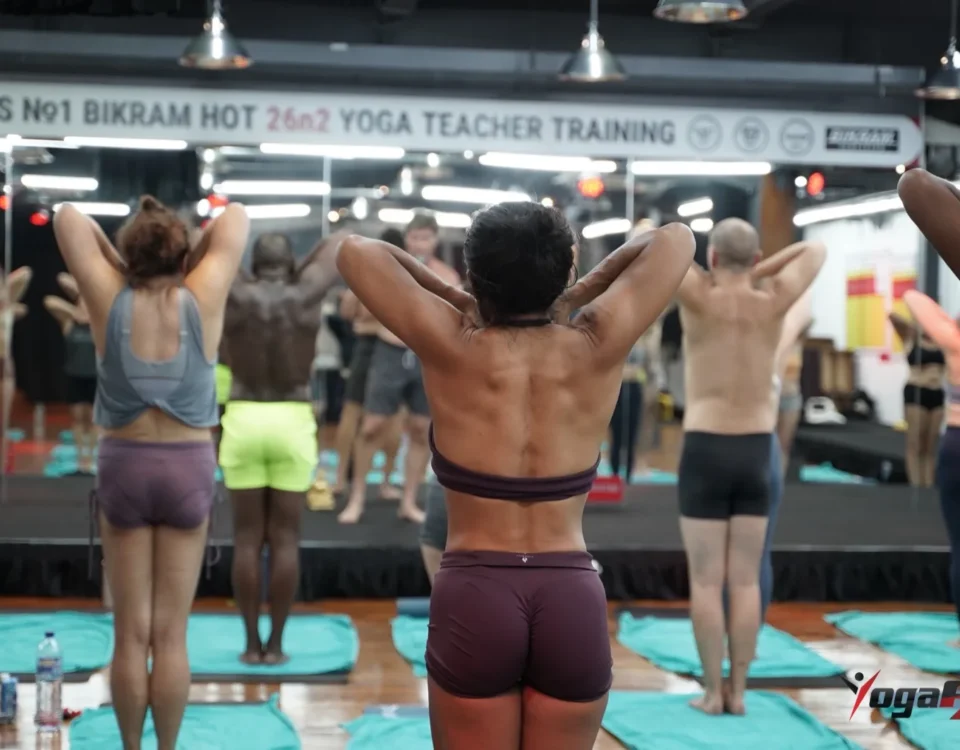
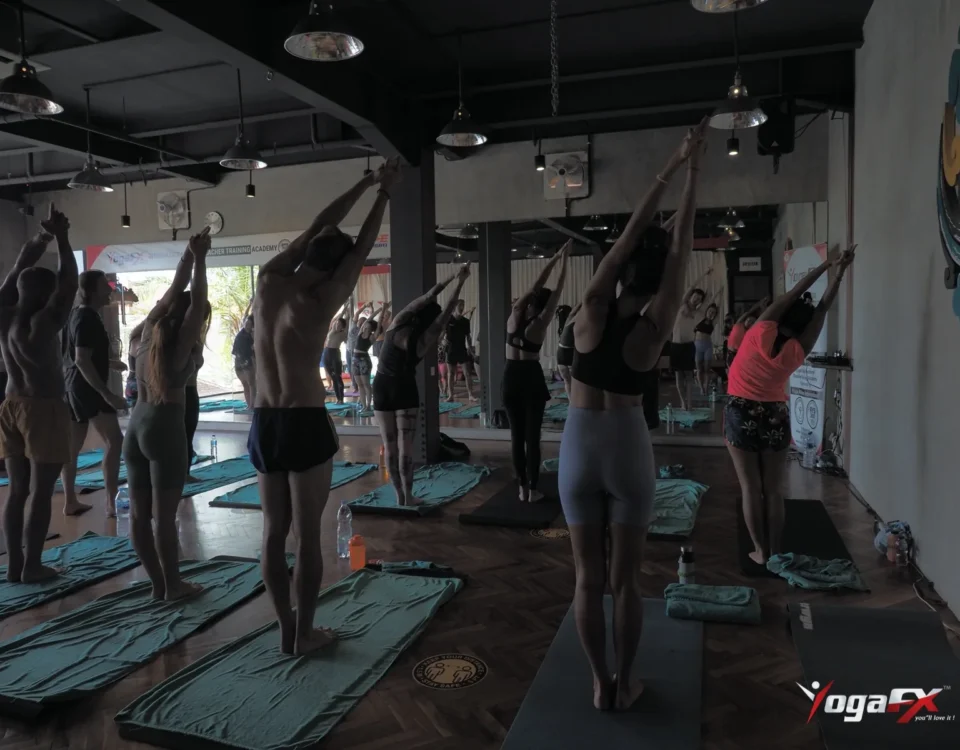
A British winter makes a hot room feel like a different country. Many students walk in from a cold street and warm up quickly. They reach this posture with tired legs. The room sits at about 40°C and 40% humidity, created by natural tropical heat, and a class lasts 90 minutes. So by the time the standing series reaches balancing stick pose, your standing ankle has already worked hard.
Three things cause most wobbles. First, sweat makes the foot slippery, so students grip with their toes. They lose the whole-foot contact that keeps them steady. Second, the arms and back leg act like a long lever, so a tiny shift at the hip becomes a big sway at the fingertips. Third, the eyes wander. In balancing stick pose, a moving gaze usually means a moving body.
The first wobble isn’t failure. It’s your foot, ankle and hip making corrections, and that’s exactly how balance gets trained. Next, we look at the five faults we see most often and the one-line cue that fixes each.
Balancing Stick Pose Wobbles and Fixes: A Quick Reference
This table pairs each wobble with its usual cause, the UK-specific trigger and a cue short enough to say in one breath. We built it from the way YogaFX trains teachers to coach balancing stick pose, where the student cannot see their own back leg.
| Wobble type | Usual first-beat cause | Why it shows up in a UK class | One-line fix |
|---|---|---|---|
| Whole-body sway | Gripping with the toes | Damp towel or mat after a cold commute | “Spread the foot like a paddle.” |
| Chest drops, back rounds | Folding at the waist | Tight desk hips | “Hinge like a gate.” |
| Back hip opens | Leg lifted too high | Chasing a high leg for the look | “Heel back, not up.” |
| Standing knee sinks | Tired standing leg | Cold-to-hot warm-up in the standing series | “Long leg, strong knee.” |
| Dizzy, drifting eyes | Gaze keeps moving | Mirror and neighbours pull the eyes | “One point, soft eyes.” |
Notice the pattern. Each cue describes a feeling or one clear action, never four things at once. A student who is shaking on one leg can act on one instruction, so a good teacher gives exactly one.
How to practise the five beats
Work through the beats from the ground up. If the line collapses, the cause is usually one beat earlier, so trace the fault backwards.
- Root first. Spread the ball of the foot and the heel evenly, and press the whole foot into the floor.
- Pick one point. Fix your gaze on a spot at eye level and keep it there.
- Hinge like a door. The chest and arms travel as one piece, so the back does not fold.
- Push the foot back, not up. A leg that lifts higher than the torso can follow only opens the hip.
- Accept a lower leg. On tight-hamstring days, a lower leg and a level chest is the right shape.
Balancing Stick Pose at a Glance
What Research Says About One-Leg Balance
We do not claim that balancing stick pose treats any condition. We use outside research to explain why the cues make sense. The sources below come from medical and university sites, and we opened each one to check it says what we describe.
The NHS balance exercises page includes a one-leg stand. It says to lift one leg, keep your hips level and keep a slight bend in the opposite leg, and to hold the lift for 5 to 10 seconds. It also suggests practising near a wall or a stable chair in case you lose your balance (NHS balance exercises). Balancing stick pose is a harder cousin of that exercise, with a forward lean, a long back leg and a hot room. So the same rule applies: good form first, then difficulty.
The hips matter too. A 2022 paper from the Medical University of Warsaw studied 51 healthy women aged 18 to 25. The authors concluded that physiological activation of the hip abductors may be important for maintaining postural balance, and they called for larger randomised studies (Bugalska et al., Acta of Bioengineering and Biomechanics, 2022). That study didn’t test yoga. It simply supports the idea that your hips work hard when you stand on one leg, so we cue them.
This is general information, not medical advice. If you have a knee, ankle, hip or back problem, or you feel dizzy standing on one leg, speak to a healthcare professional before you practise, and tell your teacher before class.
Balancing Stick Pose vs Warrior 3: What Is Different?
Searchers often ask how balancing stick pose compares with Warrior 3. Both are one-leg balances with a level torso. The difference is in the setting and the instructions. In the Hot 26&2 method the posture comes in a fixed order inside a scripted class, and the dialogue talks you through it twice.
- Arms. Hands stay together beside the ears, so the arms and ears share one line.
- Timing. The dialogue sets the pace, so you do not choose when to come out.
- Repeat. You do each side twice, which lets you compare your first and second set.
- Setting. It sits in the standing series, so your legs are already warm and working.
The standing series also includes postures that build the same base, and our guide to all 26 postures shows where each one falls. If you are new to the heat itself, read what UK practitioners should know about hot yoga safety first.
Student Voices: Learning to Trust Your Own Balance
Balance is partly a skill and partly confidence. These are real YogaFX trainees, quoted from their video reviews on our YouTube channel. Names are first names only.
Christina (YouTube review, 2024): “I’m so happy, Mr. Ian, that you pushed me and put me back in the track of my dreams.”
Jamie (YouTube review, 2024) said he was grateful for the opportunity to work hard and push himself for something he is finding a passion in, and thanked the team for holding his spot for a year.
Ruby (YouTube review, 2025) said Mr. Ian did a great job over the intensive days and told fellow trainees they would be “superstar” teachers if they keep practising (paraphrased).

Practising Balancing Stick Pose Safely in the UK
A UK class has a few realities that a Bali studio does not. Cold commutes, desk-bound hips and the odd Sunday-league knee all show up on the mat. A little preparation keeps balancing stick pose safe and useful, so here’s what we suggest.
- Arrive hydrated. Sip water through the day, not just before class.
- Use a grippy towel and mat. A secure foot makes the first beat easier.
- Stand near a wall at first. A fingertip touch is enough to calm the wobble.
- Tell your teacher about injuries. Knees, ankles and backs need an easier option.
- Stop if you feel dizzy. Lower your leg, stand tall and rest.
Teaching Balancing Stick Pose: What a Bali Intensive Adds
If you want to teach this posture, the hard part is that students cannot see their own back leg. Trainees learn to coach it with words alone. Mr. Ian Terry, Founder and Lead Instructor at YogaFX (E-RYT 500, with 12,000+ teaching hours), trains teachers to give one clear cue at a time and to trace every fault back to its first beat.
Our 6-day hybrid Bikram Hot 26&2 Yoga Teacher Training MasterClass combines pre-course online study with an intensive in Bali, and it leads to Yoga Alliance RYT 200-Hour certification plus the Bikram Hot 26&2 200-Hour International Yoga Certification. For a fair comparison, see what to compare between Bali and UK training and the cost, duration and how to choose guide. You can also try a class first with the Free 1-Day Guest Pass at our Seminyak studio.
For another posture from the same series, read our cobra pose step-by-step guide.
FAQ
What is balancing stick pose called in Sanskrit?
Balancing stick pose is called Tuladandasana. The name is usually read as tula, meaning balance or scale, and danda, meaning staff or stick. In a Hot 26&2 class you stand on one leg, reach both arms forward and tip into a level T-shape with the back leg lifted.
How long should I hold balancing stick pose?
In a scripted Hot 26&2 class the dialogue sets the hold, so you follow your teacher rather than counting. If you are practising alone, start with a short hold near a wall and add time slowly. Stop at once if you feel dizzy, and keep good form before holding longer.
Why do I wobble in balancing stick pose?
Wobbling is normal because your standing foot, ankle and hips are making constant corrections. The usual causes are gripping with the toes, a soft standing knee, hips that roll open and wandering eyes. Spread the whole foot, pick one fixed point to look at, and shorten the lever by keeping the back leg lower.
Is balancing stick pose the same as Warrior 3?
They look similar because both balance on one leg with a level torso, but the setting differs. In Hot 26&2 the hands stay together beside the ears, the dialogue sets the timing, and you repeat each side twice inside a fixed standing series in a heated room.
What if I cannot get my leg level?
That is fine. Tight hamstrings often mean the torso stays higher and the back leg stays lower. Keep the standing knee as straight as your body allows, and build the shape over weeks. Tell your teacher about any knee, ankle, hip or back problem so they can give you an easier option.
Still have questions? Message Mr. Ian and the YogaFX team on WhatsApp and we will answer them personally.