Accredited yoga teacher training in the UK means a course that a register or an accrediting body has checked. It doesn’t mean a government licence, because yoga isn’t regulated here. Yoga Alliance registers schools, YogaPros accredits courses, and each insurer sets its own rules. Ask your insurer which one it wants before you pay.

Mr. Ian Terry, E-RYT 500, hears the same question from UK applicants almost every week: will my certificate be accepted back home? This guide to accredited yoga teacher training answers it with pages you can open yourself. We cover what each label means and what UK insurers name in writing. We also explain how a Level 3 diploma differs, and give five checks to run before you pay.
What Accredited Yoga Teacher Training Means in the UK
Nobody licenses yoga teachers in Britain. YogaPros, the UK body formerly called Yoga Alliance Professionals, says so plainly on its page for teachers who trained abroad: “Yoga is not a regulated industry, so there are no universal rules about where you must train to teach.”
So the word in accredited yoga teacher training has several meanings. Four are in everyday use, and a school can mean any of them:
- Registered school. Yoga Alliance calls itself the global registry for yoga teachers and schools. A school registers a 200-hour course as an RYS, and graduates then apply to register as an RYT.
- Accredited course. YogaPros sets criteria for the courses it accredits, including at least 200 total hours and 180 contact hours that are not pre-recorded.
- Regulated qualification. A Level 3 diploma on the national framework, which you can look up on the government’s Register of Regulated Qualifications.
- School certificate. A document the school issues itself. It proves you finished that course and nothing more.
That last point is the one to watch. A registry or an awarding body adds an outside check. Without one, studios and insurers have only the school’s word. Our guide to whether you need a licence to teach yoga in the UK covers the legal side, and our explainer on what Yoga Alliance certification means for UK hot yoga teachers covers the registry side.
Which Credentials Do UK Studios and Insurers Accept?
No single credential opens every door in accredited yoga teacher training. So we read the pages of UK insurers and yoga bodies themselves on 12 November 2026. The table shows what each one says, in its own words where we could quote it.
| Credential | Who stands behind it | What the source says | How to check it |
|---|---|---|---|
| Yoga Alliance RYS or RYT | A private registry | Schools register a course, and graduates apply to register as teachers. Insure4Sport says courses accredited by Yoga Alliance or the British Wheel of Yoga “can make it easier to get insured”. | Search the school and the lead trainer by name in the Yoga Alliance directory |
| YogaPros accredited course | A UK yoga body | At least 200 total hours and 180 contact hours, none pre-recorded. Trainee insurance needs a live assessment. | Ask the school for its accreditation listing |
| Level 3 yoga certificate | A national awarding body | FitPro asks for a “supporting Level 3 Yoga, 200 Hour Yoga certificate or equivalent”. | Register of Regulated Qualifications on gov.uk |
| School certificate only | The school itself | No outside register is named for it in any page we read. | Ask your insurer in writing before you pay |
Three details that matter
Three details about accredited yoga teacher training stood out. First, both UK sources start from 200 hours. Second, YogaPros trainee cover asks for a live assessment, so a fully recorded course may fall short. Third, FitPro’s insurance page names an “internationally recognised training provider” for overseas courses but doesn’t define the term.
That gap is why a written answer from your insurer is worth more than any badge. Insure4Sport’s guide notes that Yoga Alliance accredited courses can make cover easier, not that they guarantee it.
Feb 2018
Registered
YogaFX has held Yoga Alliance RYS 200 status since February 2018.
4 of 19
Linked schools
Hot yoga trainings in our October 2026 review that are registered with Yoga Alliance.
200 h
Starting point
The course length UK insurers and yoga bodies quote first.
180 h
Contact hours
What YogaPros asks for, with none of them pre-recorded.
0
Licences needed
YogaPros: yoga is not a regulated industry in the UK.
Level 3 Diploma or Registered 200-Hour Course?
A Level 3 diploma and a registered 200-hour course both count as accredited yoga teacher training in some insurer’s eyes, but they answer different questions. Level 3 describes how demanding a qualification is. GOV.UK lists A levels, T Levels and level 3 diplomas at that level.
It also says you can use the Register of Regulated Qualifications if you know the qualification’s name and the exam board that runs it. A registered yoga school sits outside that system.
A Yoga Alliance registration works differently. It is a professional register, not a level on that framework. So the two don’t compete head to head. FitPro asks for a Level 3 yoga certificate or equivalent, while Insure4Sport points to Yoga Alliance accredited courses. Different insurers use different wording.
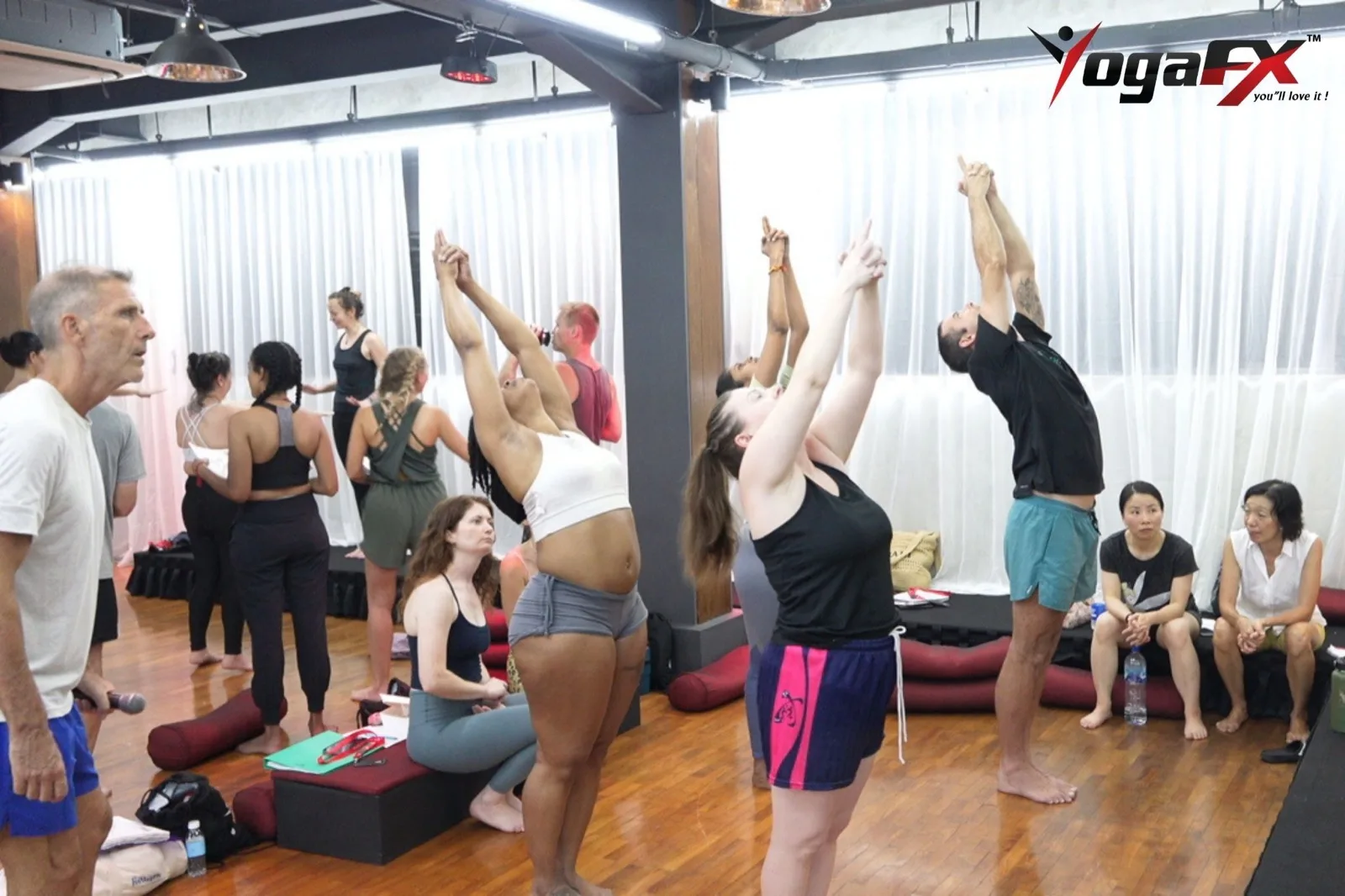
We don’t market the YogaFX certificate as a regulated Level 3 qualification, and you shouldn’t read it as one. It is a school certificate backed by a professional registration. Does your insurer want a regulated Level 3? Ask it first. Does it name Yoga Alliance? Then you have your answer.
When each route fits
- Pick a Level 3 route if your insurer or employer names Level 3 in writing, or if you want a qualification you can look up on a government register.
- Pick a registered course of accredited yoga teacher training if your insurer names Yoga Alliance or accepts a 200-hour certificate, or if you want one method, such as the 26&2 sequence, taught live by a lead trainer.
- Pick neither yet if you haven’t asked your insurer. The email takes five minutes and can save a course fee.
What We Found When We Checked 19 Hot Yoga Trainings
Applicants often ask how common accredited yoga teacher training is among hot yoga schools. So in October 2026 we reviewed 19 trainings linked to one US trade association. We used public records only. These were the Yoga Alliance directory, Google Maps, YouTube and each programme’s own pages.
Only 4 of the 19 schools are registered with Yoga Alliance. The other 15 rely on a studio certificate or a trade-association seal. Four teachers also hold a personal Yoga Alliance listing. None of the 19 publishes completion or dropout figures, so an applicant can’t see how many trainees finish.
We don’t name the schools here. The method, the dates and the tables are in our research report on the 19 linked trainings, which we wrote as analysis, not criticism. Registration isn’t perfect either. It checks a school’s paperwork rather than every classroom. Even so, it gives you something outside the school to look up.
A registered yoga school gives you a name to search. That’s the practical lesson for a UK reader. When a school advertises accredited yoga teacher training, ask who accredits it, then open that body’s directory yourself. Yoga Alliance’s own training options page explains the RYT step that follows registration.
What the Science Says About Why Teacher Standards Matter
Standards for accredited yoga teacher training exist because teachers work with real bodies. The NHS lists the signs of heat exhaustion as tiredness, dizziness, headache, feeling sick, heavy sweating, cramps and a high temperature. Its first step is to move the person to a cool place.
A hot room runs at 40 degrees C, so a teacher there needs to spot those signs and act. A good course teaches that live. Someone watches you practise.
Teachers also meet students with goals. A 2023 randomised trial of heated hatha yoga, by Nyer and colleagues in the Journal of Clinical Psychiatry, reported that 59.3% of the yoga group had a symptom decrease of 50% or more, against 6.3% of the waitlist group, over eight weeks.
It studied adults with depression in community studios. So it shows what a heated class may offer, not what every student will get.
The NHS guideline for adults is at least 150 minutes of moderate activity or 75 minutes of vigorous activity a week, plus strengthening work on at least two days. It lists yoga among the strengthening activities. A newly qualified teacher can point students to that guideline instead of promising miracles.
This section is general information, not medical advice. Anyone with a heart condition, depression or another health concern should consult a healthcare professional before starting a heated class.
How YogaFX Fits the UK Credential Picture
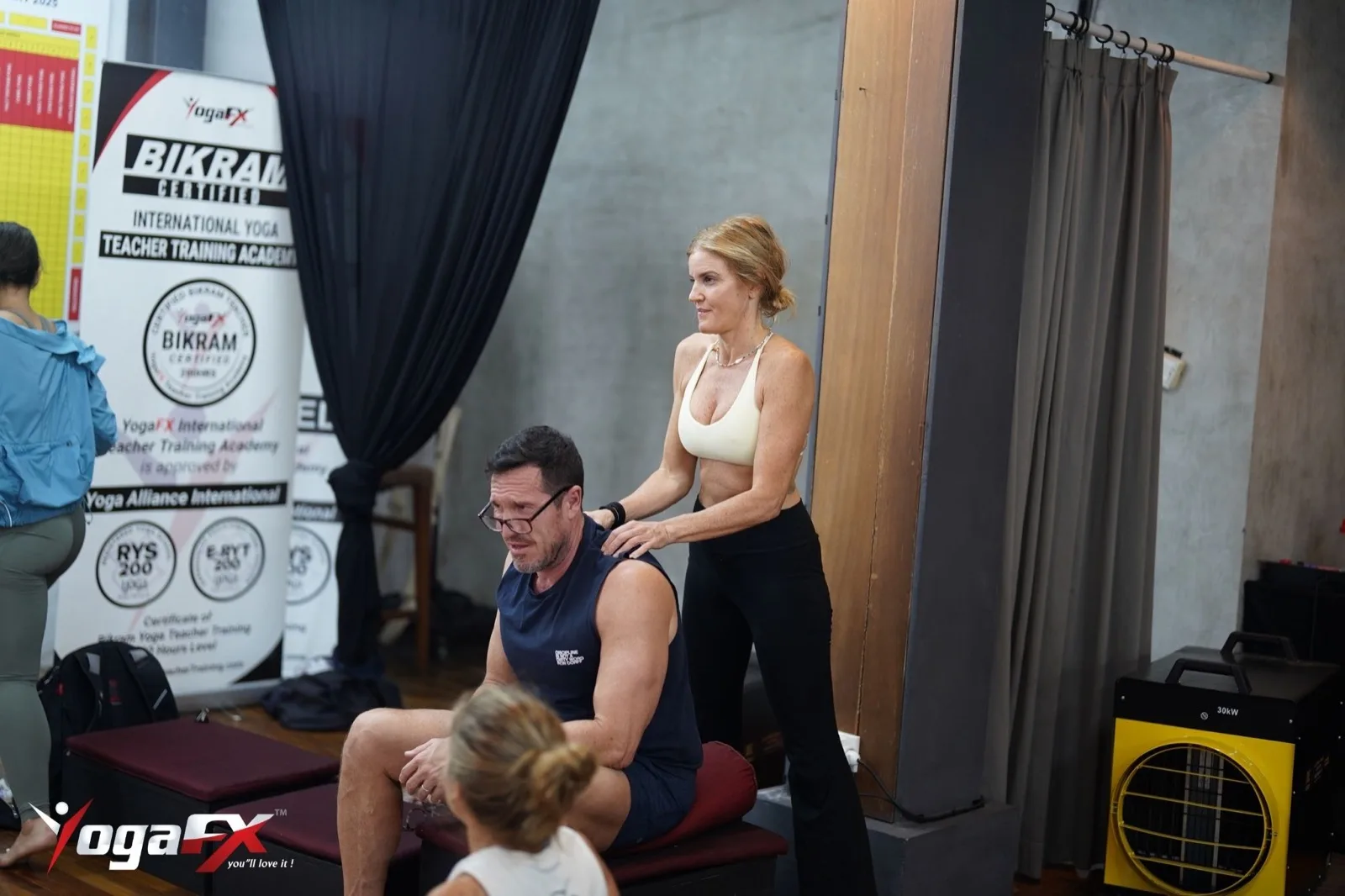
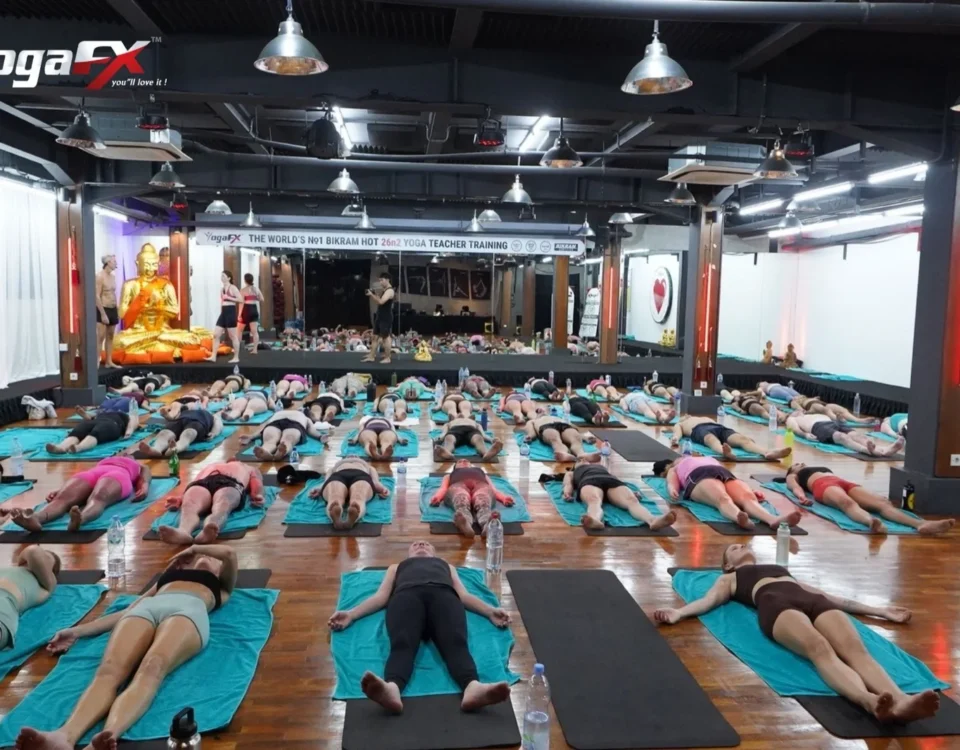
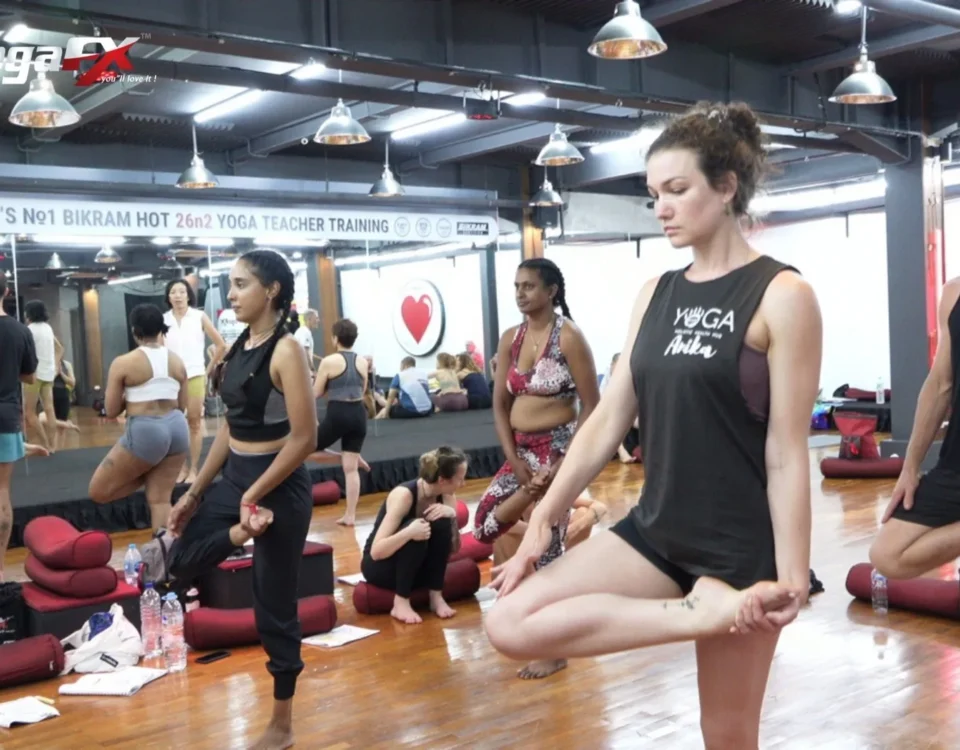
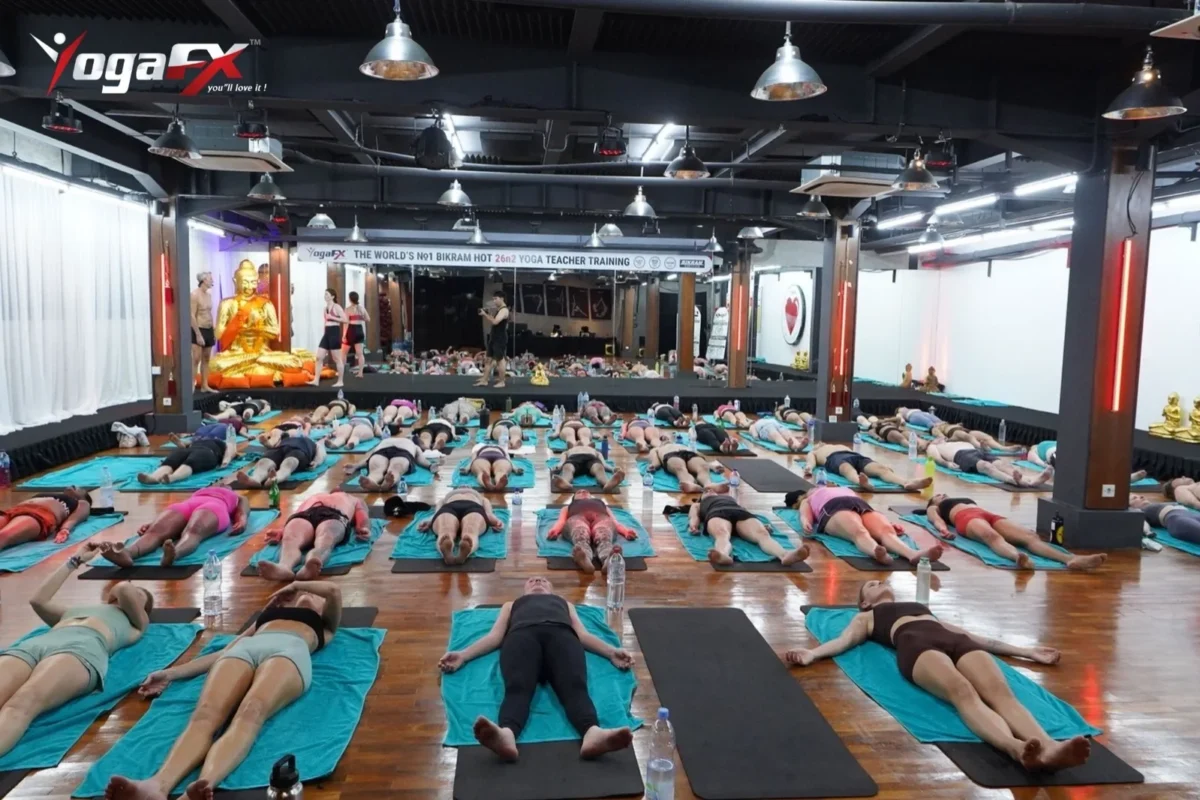
YogaFX offers accredited yoga teacher training through a hybrid programme led by Mr. Ian Terry, E-RYT 500. He has more than 12,000 teaching hours and trained for five years, from 2014 to 2019, with the founder of the Bikram Hot 26&2 method. YogaFX has been a Yoga Alliance RYS 200 school since February 2018, and more than 1,500 trainees from over 80 countries have graduated.
Graduates receive two credentials: a Yoga Alliance RYT 200 once they register, and the Bikram Hot 26&2 200-Hour International Yoga Certification. Our course details page lists everything the programme includes, and our UK home page gives the overview. If you want to study first from home, see the online teacher training course.
Format, dates and price
The format is hybrid: online preparation first, then a six-day intensive in Bali. The next batch checks in on Sunday 24 January 2027 and checks out on Friday 29 January 2027, so UK applicants need about five days off work.
The price is currently US$1,899, with instalments from US$250 a month and no interest. Prices are in US dollars, so check your bank’s rate for the pound amount on the day you pay.
We’d rather you check us than trust us. So ask every school that sells accredited yoga teacher training, including this one, how many of the 200 hours are live. If you’d like the same checks written for Bali applicants in general, our companion guide to accredited yoga teacher training Bali applicants should check works through them step by step.
What Graduates Say
Independent reviews are one of the five checks below. These three come from Google reviews of our accredited yoga teacher training. Kat wrote about the enquiry stage, before she had paid anything.
“He was always extremely informative, attentive, and kind in answering my questions, preparing me mentally for the training, and assisting me throughout the registration process and beyond.”
Kat, Google review, 2021
“I have just completed the 200-hour yoga teacher training at YogaFX in Bali. I’m ready for my new chapter as a yoga teacher.”
Uyanga, Google review, 2019 (translated)
“The teacher training experience really helped me become more confident.”
Yayuk, Google review, 2024 (translated)
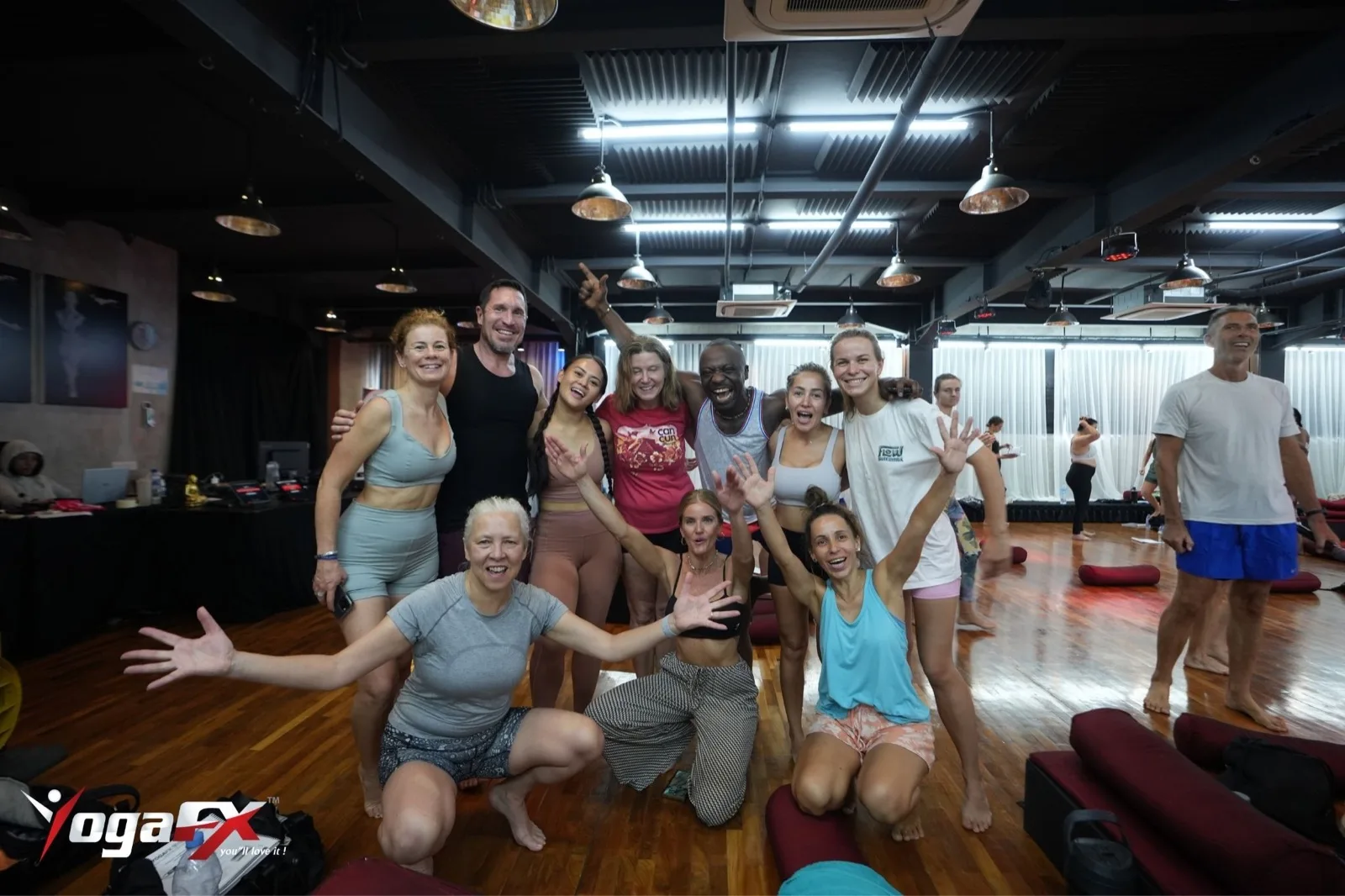
Chris recorded a video review of his training. Watch it for a trainee’s own account, in his own words.

5 Real Checks Before You Pay for Accredited Yoga Teacher Training
Whatever label a school carries, the same short routine protects your money. Do these in order and keep every answer in writing.
- Ask your insurer first. Send the course name, the hours and the certificate type, and keep the reply. It is the one answer that decides whether you can teach.
- Search the register. Look up the school and the lead trainer by exact name in the Yoga Alliance directory. Screenshot both listings and keep them with your receipt.
- Count the live hours. YogaPros asks for 180 contact hours that are not pre-recorded. Ask how many hours are live, and who watches you teach.
- Read the certificate. Ask for a sample. Find out who signs it and whether any register stands behind it.
- Check the track record. Look for reviews on independent platforms. YogaFX has 150 Google reviews, 50 Yoga Alliance reviews and 357 YouTube video testimonials, so you can compare us with any other school on your list.
If a school can’t give a clear answer to any of the five, treat that as your answer. Good accredited yoga teacher training is easy to verify, and the school should help you do it.
Common Mistakes UK Applicants Make With Accredited Yoga Teacher Training
On intake calls, Mr. Ian often hears the same four slips. All of them are cheap to avoid.
- Treating “internationally recognised” as “accepted”. The phrase appears in insurer pages without a definition. Recognised by whom?
- Paying the deposit before the insurer check. A deposit is easier to lose than to recover. Ask first.
- Trusting a seal as if it were a register. A trade-association seal can be real and still have no outside recognition. Look for a directory you can search yourself.
- Forgetting that online has limits. Online accredited yoga teacher training can teach theory well. For a scripted hot class, you still need someone to hear you teach it and correct you on the spot.
None of these mistakes means an accredited yoga teacher training course is bad. They mean the applicant skipped a check. Run the five checks above and you’ll avoid all four.
FAQ
Do you have to be certified to teach yoga in the UK?
No UK law requires it. YogaPros says yoga is not a regulated industry, so there are no universal rules about where you must train. In practice, insurers want a suitable qualification and studios want a recognised certificate, so most UK teachers complete a 200-hour course first. Always confirm with your own insurer.
Is Yoga Alliance accepted by UK insurers?
Some UK guidance points that way. Insure4Sport says courses accredited by Yoga Alliance or the British Wheel of Yoga can make it easier to get insured. That is not a guarantee, because each policy has its own wording. Send your certificate details to the insurer and keep its written reply before you pay.
What makes accredited online yoga teacher training UK-ready?
Check the live hours. YogaPros asks for at least 200 total hours and 180 contact hours that are not pre-recorded, and trainee cover needs a live assessment. A fully recorded course may fall short of that. Confirm the live teaching with the school, then confirm acceptance with your own insurer.
How long does it take to become a certified yoga instructor?
It depends on the format. The YogaFX hybrid course is online preparation followed by a six-day intensive in Bali, with the next batch running Sunday 24 to Friday 29 January 2027. Other courses run over weeks or weekends. Registering as an RYT afterwards means submitting your certificate to Yoga Alliance.
Is a Level 3 yoga certificate better than a Yoga Alliance one?
They are different things. Level 3 is a level on the national framework, and GOV.UK lists A levels and level 3 diplomas there. Yoga Alliance is a private register of schools and teachers. FitPro asks for a Level 3 yoga certificate or equivalent, so ask your insurer which one it wants.
Still have questions? Message Mr. Ian and the YogaFX team on WhatsApp and we will answer them personally, whether you ask about insurers, flights or time off work. This article is general information, not medical or insurance advice. Please consult a healthcare professional about your own health.