
Yoga Alliance certification is a listing on a private US registry, not a licence. A Registered Yoga School (RYS) trains you, then you apply to be listed as a Registered Yoga Teacher (RYT). UK law doesn’t require it, yet most UK studios and insurers ask for it. First-year fees are 115 USD, and renewal needs 75 hours every three years.

What Yoga Alliance Certification Actually Means
So what is Yoga Alliance? Most people picture an exam board. That picture is wrong, and it costs UK applicants money. Yoga Alliance is a US-based nonprofit membership organisation. Its own site describes it as a 501(c)(6) nonprofit, which is a trade association status, not a government body.
So Yoga Alliance doesn’t test you. Instead, it registers two things. It registers schools (RYS) that meet its published standards, and it registers teachers (RYT) who graduate from those schools. Your school assesses you. Yoga Alliance then confirms that your school is on its register.
That means “Yoga Alliance certification” is really shorthand. What is Yoga Alliance certification in practice? It comes down to three linked pieces:
- A certificate from your school. This proves you finished a 200-hour or 500-hour programme at an RYS.
- A listing in the Yoga Alliance directory. This is the RYT credential, and you apply for it yourself after you graduate.
- An annual membership. The listing stays live only while you pay dues and log continuing education.
For a UK hot yoga teacher, the distinction matters for one simple reason. A studio manager in Leeds or Brighton can look you up in the public directory in under a minute. If your name isn’t there, your paper certificate carries less weight, because the manager can’t verify it.
A registry, not a regulator
Because Yoga Alliance is private, it can’t stop anyone from teaching. It also can’t fine a school or take away a teacher’s right to work. So “Yoga Alliance accreditation” is a loose phrase, not a legal status.
What Yoga Alliance can do is remove a listing, set standards for schools, and collect reviews from trainees. That review system, which Yoga Alliance calls social credentialing, is one of the most useful checks a UK applicant has.
Yoga Alliance Credentials Compared: RYS, RYT, E-RYT and YACEP
The letters look like alphabet soup, but they follow a simple ladder. Schools sit on one side, teachers on the other, and experience moves you up. The table below uses the figures in the Yoga Alliance training options page and its 2025 RYT standards document.
| Credential | Who holds it | Training needed | Teaching experience needed | What it means in a UK studio |
|---|---|---|---|---|
| RYS 200 | A school | Meets the 200-hour curriculum standard | Set by Yoga Alliance school standards | Its graduates can apply for RYT 200 |
| RYT 200 | A teacher | 200 hours at an RYS 200 | None | The usual entry ticket for cover and timetable work |
| RYT 500 | A teacher | 500 hours (RYS 500, or RYS 200 plus RYS 300) | 100 hours after training | Signals deeper study, often for workshops |
| E-RYT 200 | A teacher | 200 hours at one RYS 200 | 1,000 hours over at least 2 years | Can lead parts of a 200-hour training |
| E-RYT 500 | A teacher | 500 hours | 2,000 hours over at least 4 years | Can lead teacher trainings at every level |
| YACEP | A teacher | Must already be an E-RYT | As for E-RYT | Can run continuing education courses |
Notice how steep the experience column gets. An E-RYT 500 needs 2,000 logged teaching hours. For context, Mr. Ian Terry, founder of YogaFX, holds E-RYT 500 with more than 12,000 teaching hours. That’s six times the threshold, and it’s the number to ask any lead trainer for before you pay a deposit.
For most UK readers, though, the RYT 200 row is the one that counts. It’s the level of Yoga Alliance certification that studios ask for first, and the higher tiers can wait until you’ve taught for a few years.
Yoga Alliance certification requirements in five numbers
If you only remember five figures about Yoga Alliance certification requirements, make it these.
200 hours
Minimum training
Completed at a Registered Yoga School before you can apply as RYT 200.
115 USD
First-year cost
A 50 USD one-time application fee plus 65 USD annual dues.
75 hours
Every 3 years
45 teaching hours plus 30 training hours keep your listing active.
14 days
School confirmation
The longest your school should take to confirm your training online.
2,000 hours
E-RYT 500 teaching
Logged over at least four years before you can lead trainings.
What Yoga Alliance Certification Costs and How It Renews
Yoga Alliance certification is cheap next to the training itself. According to the Yoga Alliance guide to the RYT application process, the standard route costs:
- 50 USD application fee, paid once and not refundable.
- 65 USD annual membership dues, every year you stay listed.
- 115 USD in total for your first year.
Yoga Alliance bills in US dollars. As a result, a UK teacher pays the sterling equivalent at whatever rate their card or bank applies on the day. It’s worth using a card without a foreign transaction fee, because that fee repeats every year with your dues.
Experienced teachers who trained outside the system have another door. The Experienced Teacher Pathway costs 85 USD to apply, or 150 USD in the first year. However, it asks for at least 3,000 documented teaching hours, a yoga CV and three references.
The renewal rule most new teachers miss
Yoga Alliance certification doesn’t last forever on its own. You need 75 hours of continuing education every three years, counted from your registration date. Of those, 45 are teaching hours and 30 are training hours. Training you did before you registered doesn’t count towards your first cycle, and extra hours don’t roll over.
In practice, a UK teacher who covers two classes a week clears the teaching hours easily. The 30 training hours need planning, though. Many teachers book one workshop weekend a year, which spreads the load.
Whether all of this is good value is a fair question, and our honest look at whether Yoga Alliance is worth it for UK teachers weighs the dues against what you get back.
Is Yoga Alliance Certification Recognised in the UK?
Yes, Yoga Alliance certification is widely recognised, but recognition is informal. There’s no statutory licence to teach yoga in England, Scotland, Wales or Northern Ireland. So no single body “approves” UK yoga teachers by law. Instead, studios, gyms and insurers decide for themselves which credentials they trust, and Yoga Alliance certification is the one they see most often.
You’ll also meet a UK registry with a confusingly similar name. Yoga Alliance Professionals is a separate not-for-profit company based in Edinburgh, and it’s a different organisation from the US body. Its foundation standard is 200 hours with 180 contact hours. Some UK employers accept either, so check the job advert rather than assuming.
For the legal side, including insurance and what “licence” really means here, read our guide to the yoga instructor licence question in the UK.
What UK hot yoga studios usually check
A hot studio hires differently from a gym timetable. The room is 40°C, and the class follows a fixed sequence. That’s why managers tend to look at a short, practical list:
- An active RYT listing they can search in the public directory.
- A style-specific certificate for the method they teach, such as the Hot 26&2 dialogue.
- Public liability insurance that names hot yoga as a covered activity.
- An audition class, because script timing and room-reading show up within minutes.
How to Get Yoga Alliance Certification, in Brief
The route to Yoga Alliance certification is short. The hard part is the training, not the paperwork. Here it is in four lines:
- Check the school in the Yoga Alliance directory before you pay anything.
- Complete the 200 hours and keep your certificate and exact dates.
- Apply online, upload the certificate and wait for your school to confirm.
- Pay and review your school to finish the listing.
Each step has small traps, such as end dates that don’t match the certificate. We cover them screen by screen in our walkthrough on how to get certified to teach yoga, so this guide stays on what the credential means.
Can you get Yoga Alliance certification online?
Yes. Yoga Alliance let schools teach fully online in 2020 and made online delivery a permanent option in 2023. So the format isn’t the barrier. The school’s RYS status is. For hot yoga, though, you still need to teach in a real heated room at some point, because heat changes everything about pacing and safety.
Why Hot Yoga Teachers Need More Than Registration
Here’s the uncomfortable truth. Yoga Alliance certification tells a studio that you finished 200 hours somewhere. It doesn’t tell them which method you can teach. A great many schools hold RYS status, and many of them teach general hatha or vinyasa.
A Hot 26&2 class is different. It runs 26 postures and 2 breathing exercises in the same order for 90 minutes. The teacher speaks a scripted dialogue, with no music and no demonstration. A manager hiring for that class is hiring for script accuracy and timing, which a general RYT 200 doesn’t cover.

That’s why UK hot studios often want two documents. First, the RYT listing. Second, a certificate for the method itself. Our guide to what a Bikram yoga certification includes explains what that second credential should cover, from posture clinic to dialogue delivery.
So when you compare trainings, ask three questions. Is the school an RYS? Do you leave with a separate method certificate? And how many teaching hours does the lead trainer have? The answers sort serious programmes from paper ones quickly.
The Science: Why a Heat-Trained Teacher Matters
The research on hot yoga is encouraging, and it’s also a reason to take teacher training seriously. A 2025 systematic review by Willmott and colleagues pooled 43 studies with 942 participants on Bikram-style hot yoga. It reported benefits for flexibility, well-being and other health markers, while noting that study quality varies.
Mental health findings stand out too. In an eight-week Massachusetts General Hospital trial (Nyer et al., 2023, Journal of Clinical Psychiatry), 59% of participants in heated yoga classes saw their depression symptoms fall by half or more. The figure for the waitlist group was 6.3%, as the Harvard Gazette report on the trial explains.
Separately, a 2022 study by Hui and colleagues found that hot yoga reduced state anxiety.
However, the same heat that drives these results adds risk. The NHS guidance on heat exhaustion and heatstroke lists warning signs every hot yoga teacher should spot from the podium:
- Dizziness, headache and tiredness.
- Nausea, cramps, and pale, clammy skin.
- Confusion or hot skin that has stopped sweating, which the NHS treats as an emergency.
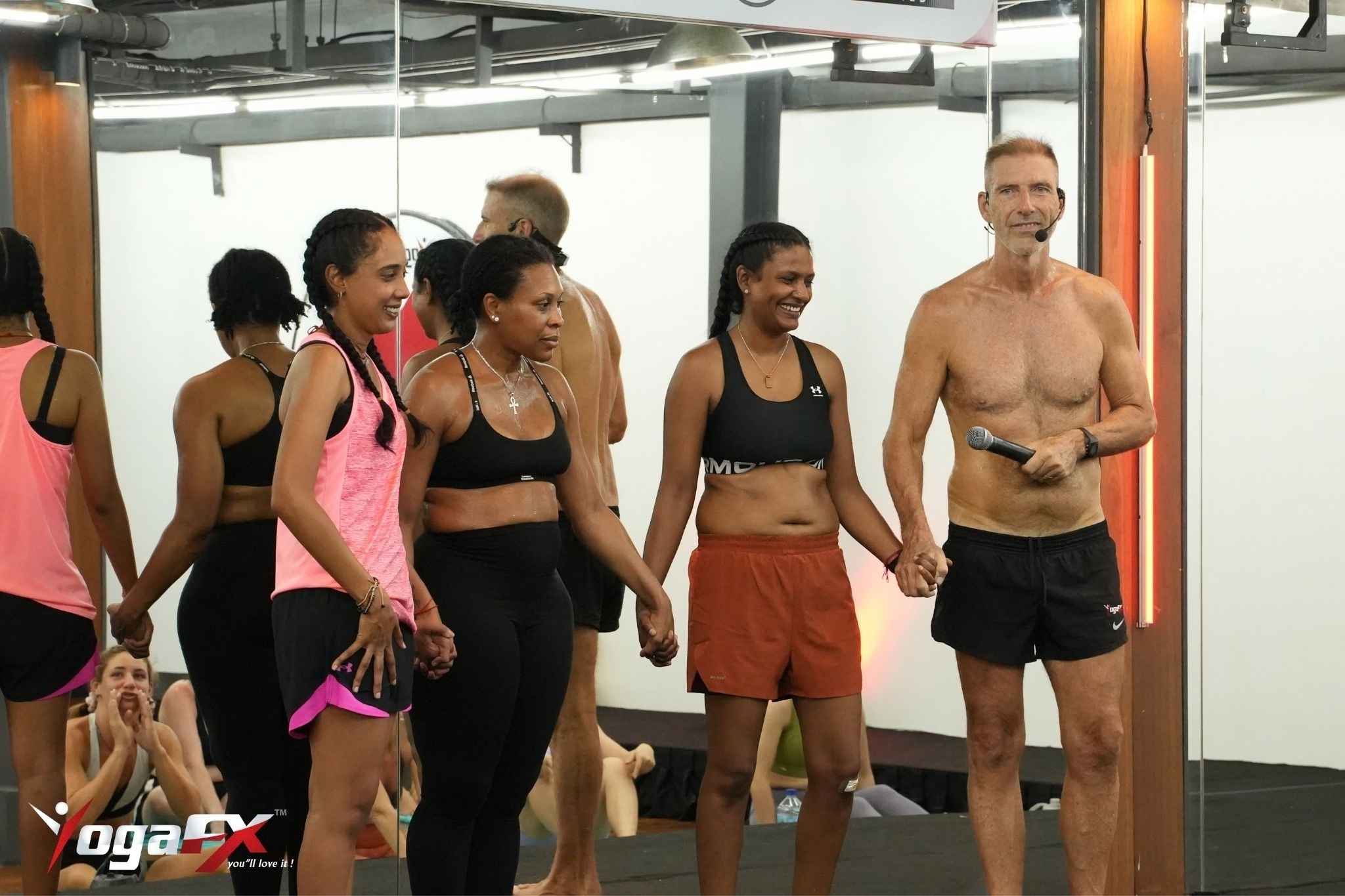
A general course that leads to Yoga Alliance certification may never mention any of this. In contrast, a heat-specific training drills it, because a teacher in a 40°C room is managing hydration, pacing and rest for every student at once.
Research suggests hot yoga may help many people, but it isn’t right for everyone. If you have a heart condition, are pregnant or take regular medication, consult a healthcare professional before you practise or train.
What Graduates Say About the Certificate
Numbers only tell part of the story of Yoga Alliance certification. Here’s how three YogaFX graduates described what the certificate meant once they held it.
“The reality is we’ve all come out with two certificates that we can now teach confidently as professionals anywhere in the world as yoga teachers.”
Jilly, YouTube review, 2019
Jilly’s point is the practical one. Two certificates, the RYT listing and the method credential, open two different doors.
“It’s not only just about getting the certification. I think it’s just the connections we’ve all made.”
Mayuri, YouTube review, 2026

“I know that it’s not about the certificates.” She said the training helped her “trust myself more”.
Atika, YouTube review, 2019
Those three views fit together. The certificate gets you the audition, but the confidence you build in training gets you the job. YogaFX also holds 50 reviews on its Yoga Alliance school listing and 150 on Google, so you can read many more before you decide.
Yoga Alliance Certification With YogaFX: Bali Compared With Staying in the UK
Most UK routes to Yoga Alliance certification spread 200 hours across months of weekends. That suits some people, and our guide on Bikram yoga teacher training on weekends shows how that format really works. For others, especially those with fixed annual leave, a hybrid model works better. YogaFX runs its Bikram Hot 26&2 Yoga Teacher Training MasterClass as self-paced online study at home, followed by a 6-day intensive in Seminyak, Bali.
The training is led by Mr. Ian Terry, E-RYT 500. He has more than 12,000 teaching hours and spent five years, from 2014 to 2019, training with the founder of the Bikram Hot 26&2 method.
Since 2017 he has trained 1,500+ graduates from more than 80 countries. In June 2026 he was also confirmed as Master Trainer of the Republic of Indonesia Yogasana Sports Federation.
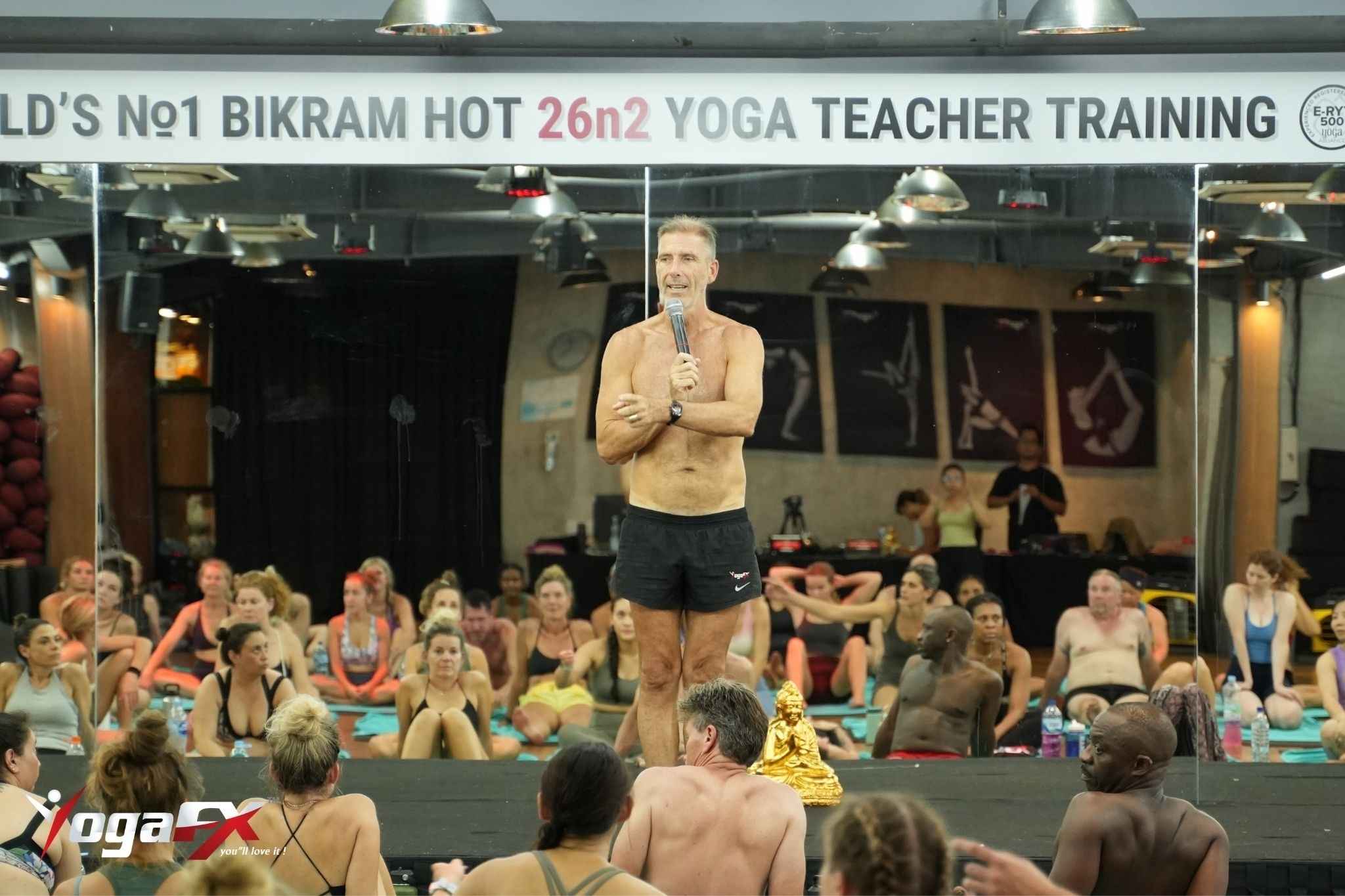
Graduates leave with Yoga Alliance certification and a method credential, which answers the UK hiring checklist above:
- Yoga Alliance RYT 200, so you can register and appear in the directory.
- Bikram Hot 26&2 200-Hour International Yoga Certification, the method credential hot studios ask for.
- A YACEP option for teachers who are already certified and want continuing education hours instead.
The next batch checks in on Sunday 24 January 2027 and checks out on Friday 29 January 2027, at the Soham Wellness Center in Seminyak. That means about five working days off for most UK applicants. The Early Bird price is US$1,899, saving US$100 on the standard US$1,999. Twin share is US$1,999 and a premium single room is US$2,199.
If paying in one go is hard, instalments start from about US$250 a month with no interest. You’ll find every intake on our course dates page, along with what’s included in the price.
FAQ: Yoga Alliance Certification for UK Teachers
Is Yoga Alliance recognised in the UK?
Yes, informally. The UK has no legal licence for yoga teachers, so recognition comes from employers and insurers. Most UK studios and gyms know Yoga Alliance and accept an RYT listing as proof of training. Hot yoga studios usually also want a method certificate, such as a Hot 26&2 credential, on top of RYT 200.
Does Yoga Alliance certification expire?
Your school certificate doesn’t expire, but your listing can lapse. To stay active you pay 65 USD annual dues and log 75 hours of continuing education every three years. That means 45 teaching hours and 30 training hours. Hours don’t roll over, and training done before you registered doesn’t count for the first cycle.
How much is Yoga Alliance certification?
Yoga Alliance certification costs 115 USD in the first year: a 50 USD one-time application fee plus 65 USD dues. After that you pay 65 USD a year. Yoga Alliance charges in US dollars, so UK teachers pay the sterling equivalent. The training itself is a separate cost, set by each school.
What is the difference between Yoga Alliance and Yoga Alliance Professionals?
They are separate organisations. Yoga Alliance is a US nonprofit that registers schools and teachers worldwide. Yoga Alliance Professionals is a not-for-profit company based in Edinburgh with its own standards, including a 200-hour foundation level with 180 contact hours. Check which one a UK employer names before you choose a training.
Is Yoga Alliance certification necessary to teach hot yoga?
It isn’t legally necessary anywhere in the UK. In practice, though, most studios and insurers expect an RYT listing, and many won’t audition a teacher without one. For hot yoga, studios also look for heat-specific training, because teaching safely at 40°C needs skills a general course may not cover.
Still have questions? Message Mr. Ian and the YogaFX team on WhatsApp and we’ll answer them personally, including how the RYT 200 application works after your training.