The Bikram yoga dialogue is the fixed set of spoken instructions a teacher uses to lead a 90-minute class through 26 postures and 2 breathing exercises. It took shape in the United States in the 1970s. A UK trainee can learn it in stages: regular classes, home study, then six days of feedback in Bali.

If you are weighing up a teacher training from the UK, the dialogue is the part that worries people most. It sounds like a huge amount to memorise. This page explains where the Bikram yoga dialogue comes from, what a US court said about it, and how a trainee learns it step by step.
The view here comes from Mr. Ian Terry, E-RYT 500, who trained for five years, from 2014 to 2019, with the founder of the Bikram Hot 26&2 method. He has taught more than 12,000 hours, and 1,500+ graduates from 80+ countries have trained with YogaFX since 2017.
We write for UK readers, so the route below covers practical points too: home study, time off work and the time difference with Bali. For a student-side view of how the words sound in a normal class, read what the dialogue sounds like from a student’s seat.
Bikram Yoga Dialogue Origin: From Calcutta to a 1979 Book
The postures trace back to Bishnu Charan Ghosh, a Calcutta teacher who stressed physical conditioning and targeted posture work. His student, Bikram Choudhury, brought that approach to the West in the early 1970s. In the United States he fixed the postures into one class of 26 postures and 2 breathing exercises, run for 90 minutes in a heated room.
The spoken part came with it. Because the order never changes, the words that guide each posture can stay the same too. That is the Bikram yoga dialogue in one sentence. It is also why a teacher in London and a teacher in Bali can lead the same class without a single demonstration or a note of music.
Three search terms, one thing
People look for the Bikram dialogue, the 26 and 2 dialogue and the yoga teacher dialogue as if they were three separate things. They are one. The name on the studio door changed after 2015, but the spoken instructions kept their shape. If a class follows the same words in the same order every time, you are hearing the same Bikram yoga dialogue under a newer label.
What the public record shows
Here we have to be careful. The postures have a well-known lineage, but nobody has published a tidy story of who first wrote each spoken line, and we will not invent one. What the record does show is a book and a court opinion.
The book is Bikram’s Beginning Yoga Class, published in 1979. The US Ninth Circuit later described the Sequence as set out in that book. It also described the class itself, which is practised, in the court’s words, “to a series of instructions (the ‘Dialogue’).” So the term is not a marketing label. The Bikram yoga dialogue appears in a federal court opinion.
What a US Court Said About the Dialogue in 2015
On 8 October 2015 the Ninth Circuit decided Bikram’s Yoga College of India v. Evolation Yoga. The case asked whether the Sequence could be protected by copyright. The judges said no, and the wording matters for anyone who teaches it. You can read the full opinion on the court’s website.
The court held that, “at bottom, the Sequence is an idea, process, or system designed to improve health.” That means copyright did not stop other studios from teaching the postures in the same order. It is also why the sequence now appears under many names.
This is general information, not legal advice, and a US ruling does not bind a UK court. For the British side of the story, see our page on Bikram yoga history in Britain. What matters here is simpler. The Bikram yoga dialogue is a real, documented part of the class, and learning it is a skill you can practise.
How to Learn the Bikram Yoga Dialogue: A 5-Stage UK Route
Nobody learns the Bikram yoga dialogue in a weekend. The route below puts the work where it fits best: most of the hearing happens in classes, most of the memorising happens at home, and most of the delivery practice happens in the room with a trainer.
| Stage | What you do | Where | Time frame |
|---|---|---|---|
| 1. Build your practice | Take regular hot 26&2 classes, so you hear the dialogue again and again. | A UK studio or in Bali | 3 to 4 classes a week for 3 to 6 months, if you are new |
| 2. Know the sequence | Learn the posture order, the entry and exit points and the safety changes. | In class and at home | Alongside stage 1 |
| 3. Study online | Use the YogaFX Pre-Course MasterClass Preparation that opens when you enrol. | At home | Before you fly |
| 4. Deliver it live | Speak the dialogue aloud, with timing and feedback from the trainer. | Seminyak, Bali | 6 days |
| 5. Keep going | Use lifetime Training Support on the YogaFX Online Academy, including Dialogue Demonstrations and Posture Clinics. | Online | After graduation |
Notice that stage 4 is only six days long. That is deliberate. Because the memorising starts earlier, the time in Bali goes on delivery: how fast to speak, where to pause and how to correct a student without breaking the flow.
Why stage 1 comes first
Every hour in a class is an hour of listening to the Bikram yoga dialogue. By the time you enrol, the rhythm is already in your head. As a result, learning the words feels like filling in a familiar shape, not building a new one.
YogaFX suggests 3 to 4 classes a week, for at least 3 to 6 months, for newer students. If you already practise more than that, you are ahead. If you are not sure where you stand, ask before you book anything. For the wider options, our complete UK guide to Bikram yoga teacher training compares them.
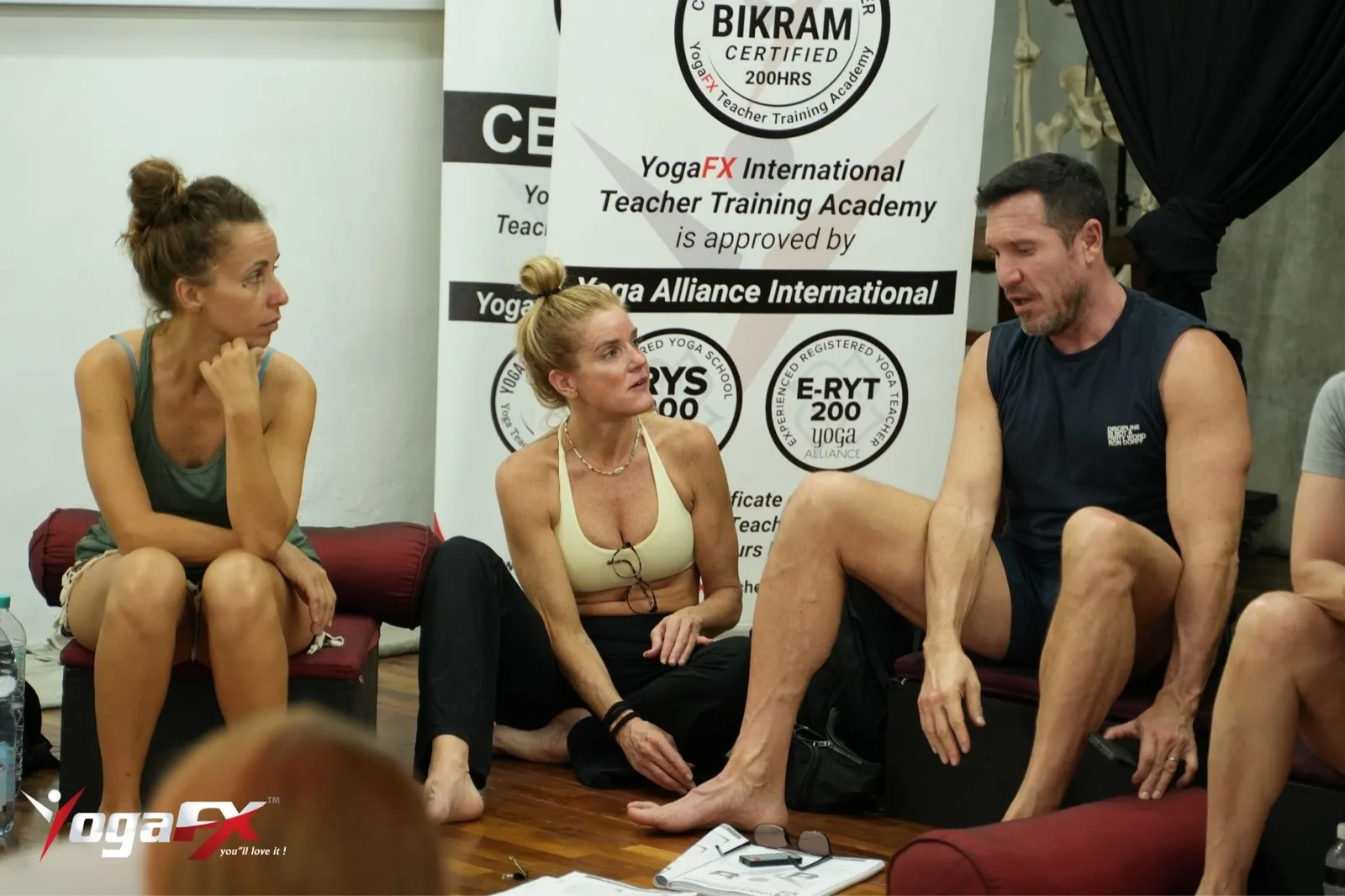
Four mistakes to avoid when learning the Bikram yoga dialogue
- Rereading instead of speaking. Silent reading feels productive, but it does not train your voice.
- Learning words without timing. The Bikram yoga dialogue works because of its pauses as much as its phrases.
- Cramming in the last week. Short sessions over weeks hold up better than one long push.
- Skipping classes. If you stop hearing the dialogue, the rhythm fades.
What Learning Science Says About Memorising a Script
Learning the Bikram yoga dialogue is a memory task, so research on memory helps. We rely on non-yoga sources here, because they test the learning method rather than the class.
A 2006 study in Psychological Science, titled Test-enhanced learning, reports that on delayed tests, prior testing produced substantially greater retention than studying. In plain terms, saying the words from memory beats rereading them. The same abstract adds a caveat: after only five minutes, repeated studying did better, so rereading helps only over a very short window.
Timing matters too. A 2006 review in Psychological Bulletin pooled 839 assessments from 317 experiments. It found that the best gap between practice sessions grows as the time you need to remember grows. So a trainee who needs the words in ten weeks should space practice differently from one who needs them tomorrow.
- Retrieve, don’t reread. Cover the page and say the words aloud first.
- Space it out. Several short sessions across days beat one long evening.
- Add gradually. Hold on to old postures while you add one new posture at a time.
These findings come from general memory research, not from a study of the dialogue itself. We use them as a sensible guide, not a promise.
On health, one trial gives context for why people stay with the class. A 2023 Massachusetts General Hospital trial, reported by the Harvard Gazette, randomised 80 adults with depression. After eight weeks, 59% of the yoga group had cut their symptoms by half or more, against 6.3% of the waitlist group. The Gazette notes that future work must compare heated and non-heated yoga.
Research suggests benefits, but it does not make hot yoga a treatment. If you have a medical condition, consult a healthcare professional first.
Practising the Bikram Yoga Dialogue at Home Before Bali
This is where a UK trainee has an advantage. You can start in your own living room, in short sessions, long before the flight. The full script is not published officially, so your study material comes from the trainer after you enrol. Until then, you can build the habit.
Here is a four-week pattern we suggest. It is our own plan, built on the memory research above, and not a trial result:
- Day 1: read the words for one posture, then close the notes and say them aloud.
- Day 2: say them again before you look, then check what you missed.
- Days 4 and 7: repeat, then add the next posture.
- Every week: stand up and run every posture you know, in order, as if a room were listening.
About 20 minutes a day is enough for most people. Short and regular beats long and rare. If a week goes badly, repeat it instead of rushing on.
Three UK points to plan around
- Time difference. Bali is 8 hours ahead of the UK in January. A call that suits Bali’s evening lands around UK lunchtime.
- Time off. Check-in is on a Sunday and check-out is on a Friday, so the in-person part is built around one working week. Our page on how long it takes to become a yoga teacher helps you plan leave.
- A personal call first. Applicants speak with Mr. Ian before they enrol, so you can ask about your own starting point with the Bikram yoga dialogue.
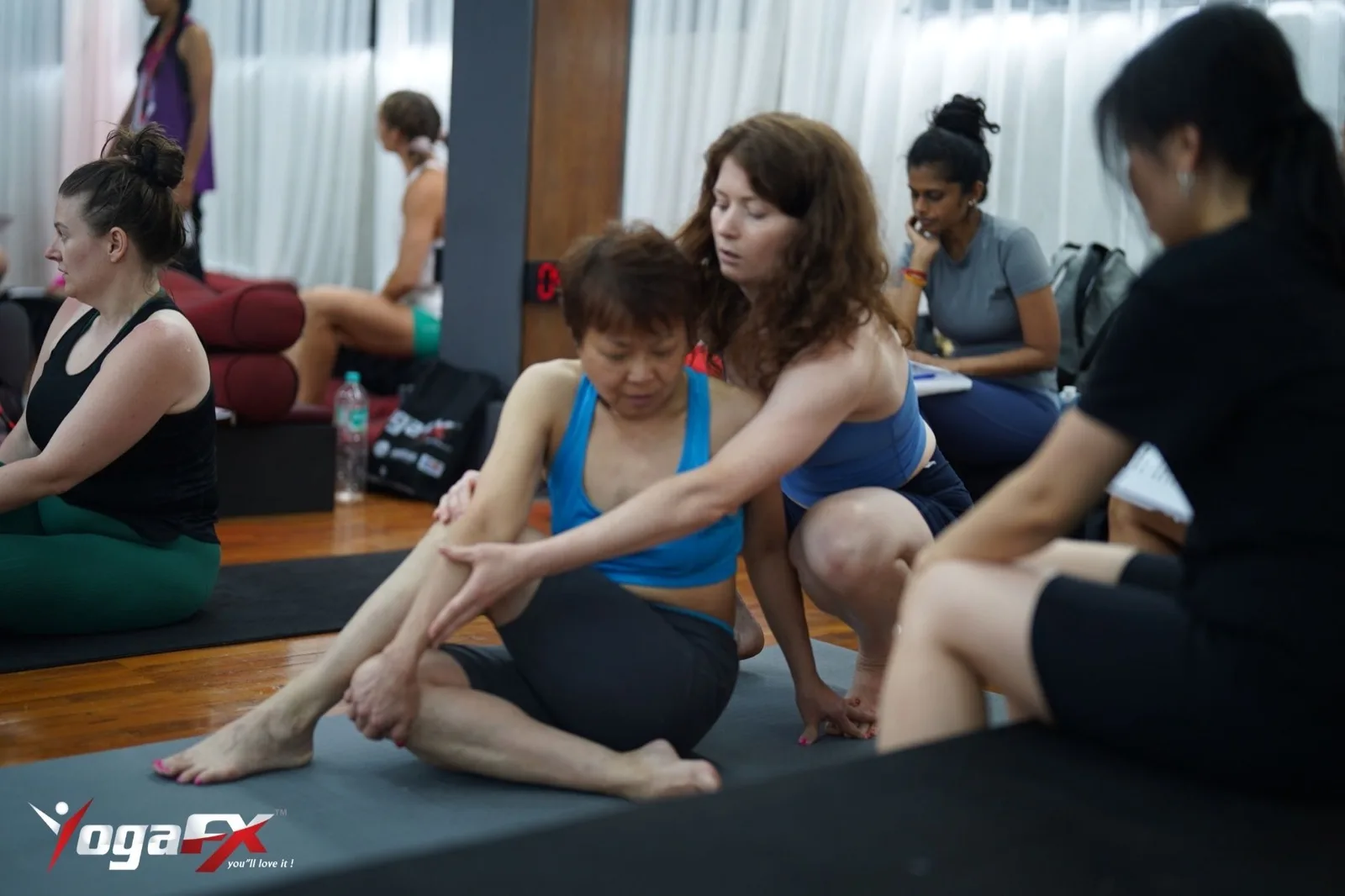
What the Six Days in Bali Add to the Bikram Yoga Dialogue
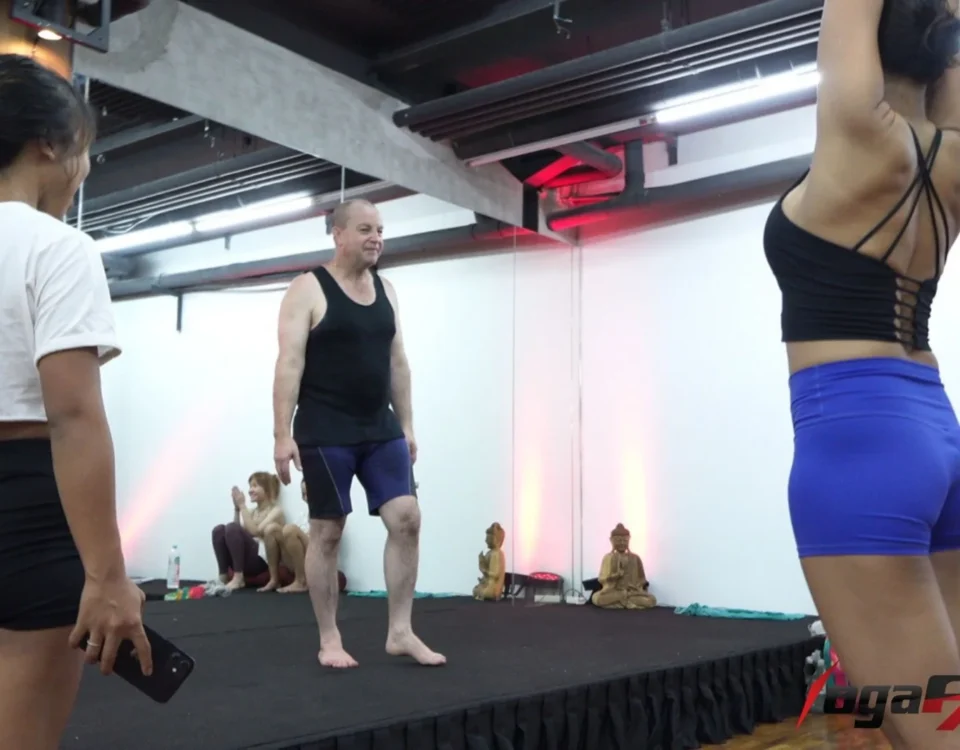
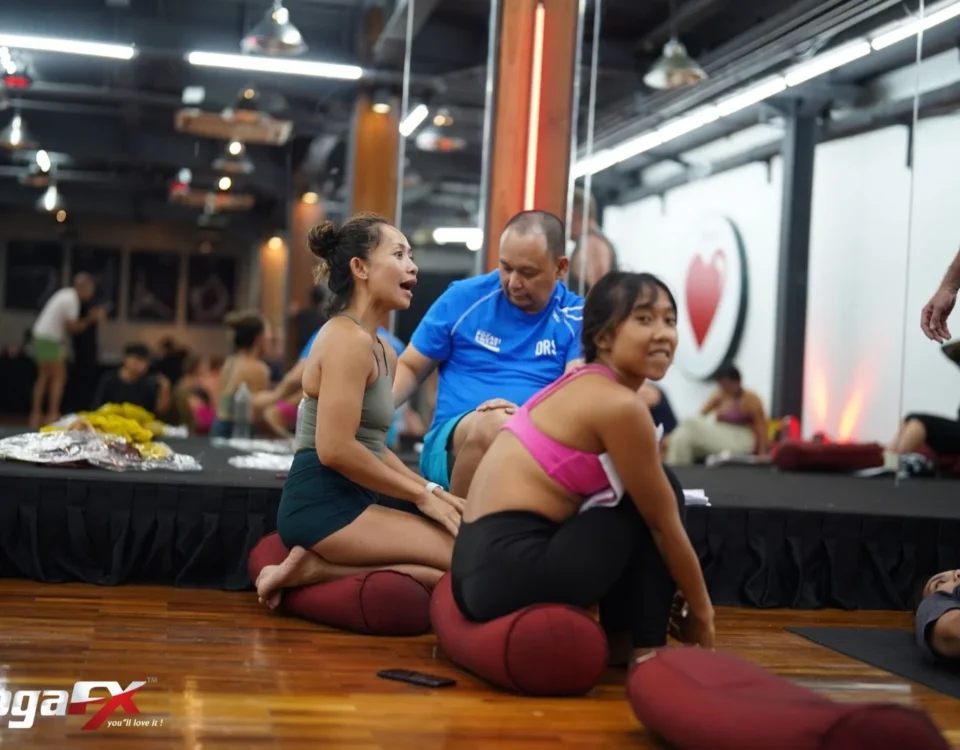
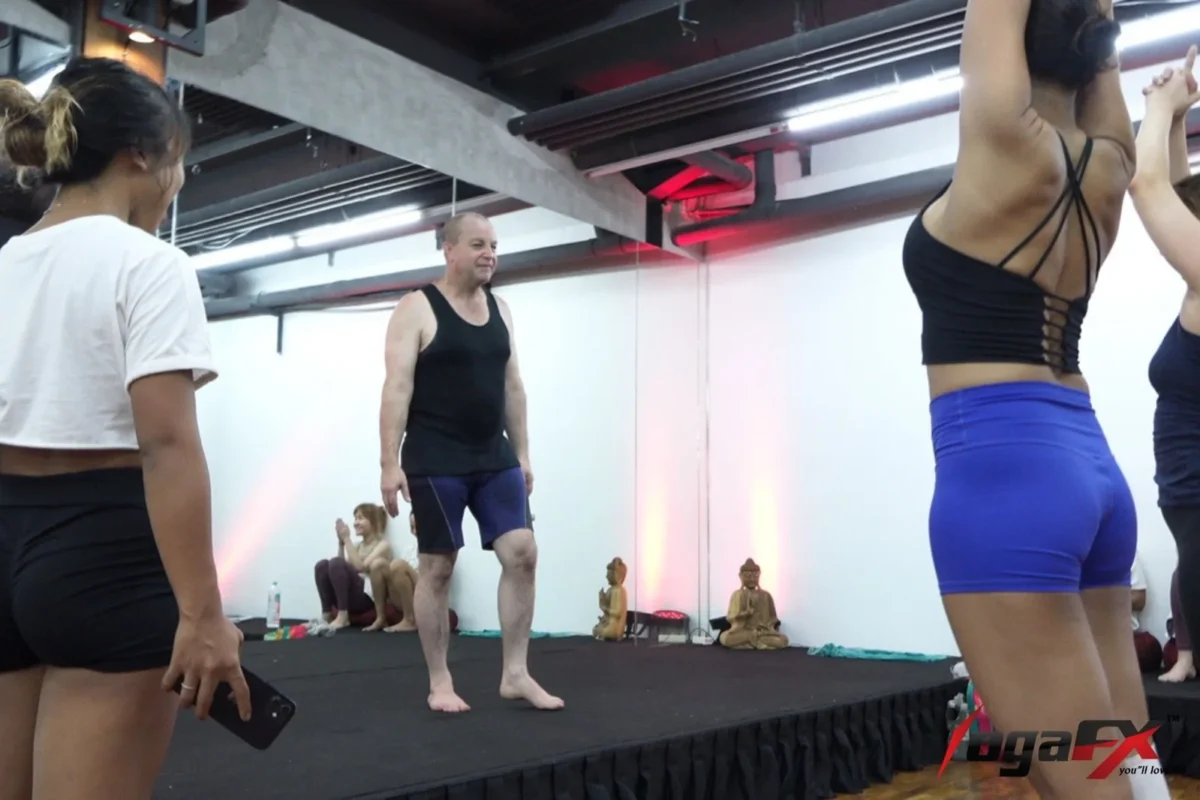
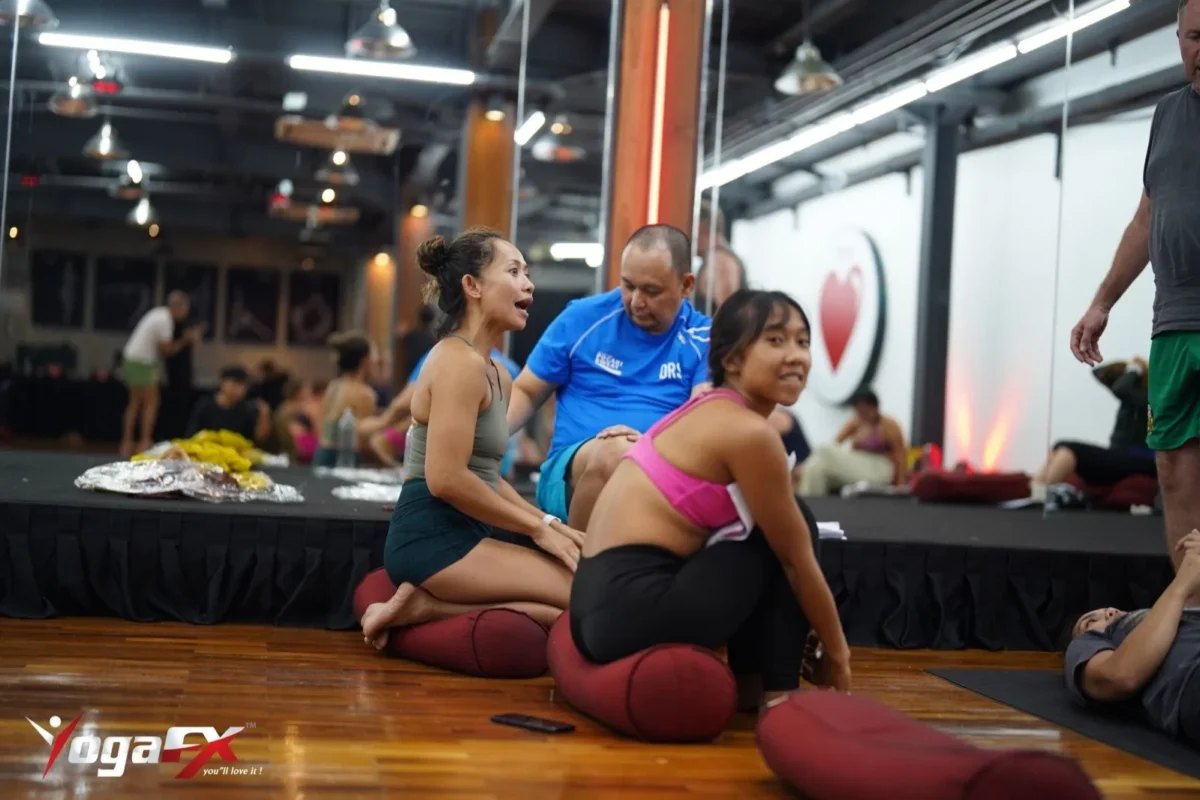
By the time you arrive, you should know most of the Bikram yoga dialogue. The six days add what no home study can: a trainer who listens while you speak. Mr. Ian Terry has taught the Bikram yoga dialogue for more than 12,000 hours, so he can hear a rushed cue or a lost pause at once.
The next intake runs from check-in on Sunday 24 January 2027 to check-out on Friday 29 January 2027, at Soham Wellness Center in Seminyak. Every trainee practises delivering the dialogue out loud, then gets feedback straight afterwards. That cycle is the same one the memory research points to: retrieve, check, repeat.
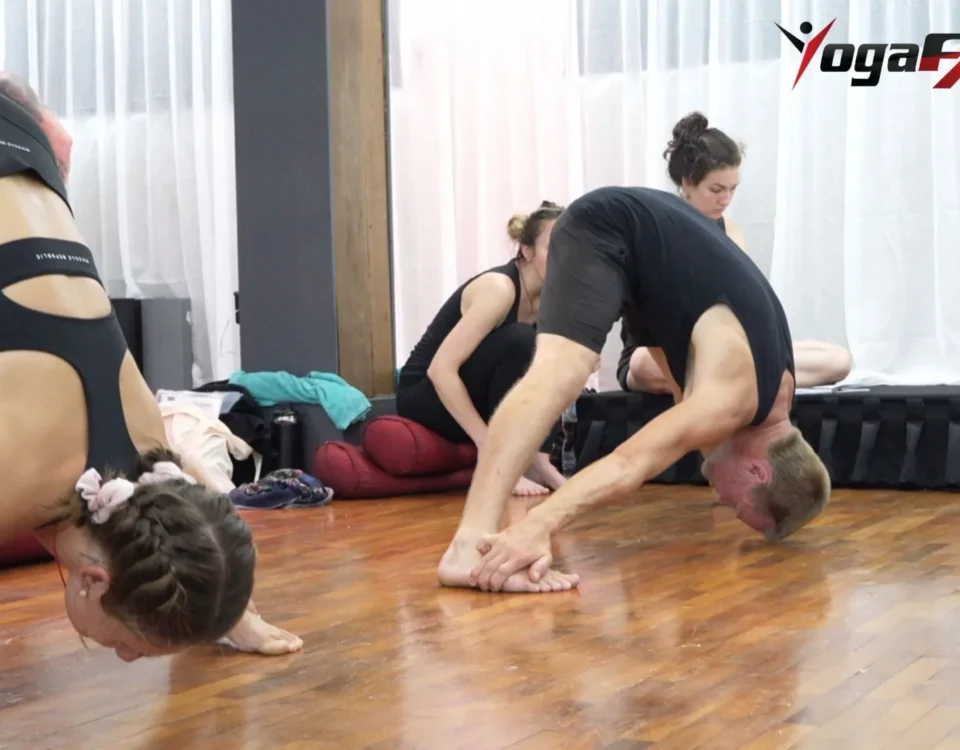
Posture clinics sit alongside the dialogue practice. The progress board in the photo above shows the idea: every trainee’s name, every posture, and a tick when it is done. Because everyone works from the same Bikram yoga dialogue, feedback is concrete: too fast here, a missed cue there.
Training days are hot, so fitness matters. The class runs at about 40°C with 40% humidity, using natural tropical heat. Trainees who already practise in a hot room arrive used to that. If you do not, build up your classes first.
What Trainees Say About Learning the Dialogue
Our students have left 150 Google reviews, 50 Yoga Alliance reviews and 357 YouTube video testimonials. These three, shown with first names only, speak to how the learning is structured and taught:
“The entire program was clearly structured with a view to actually implementing the learning; there was no abstract, ambiguous learning.”
Amanda, Yoga Alliance review, 2019
“Mr. Ian is both tough on us when necessary, and loving when called for.”
Liz, Google review, 2025
“The way the teachings are passed down with respect for lineage, structure and integrity made me feel honoured to be learning this practice.”
Sophie, Google review, 2026
Lily also shared her experience on camera in 2025. Her YouTube review is below.

Is This Route Right for You? Health, Cost and Time Checks
Before you commit, run three quick checks. They take an evening and save you a lot of doubt.
- Health. Heat raises your heart rate. Speak to your GP if you have a heart or blood pressure condition, or if you are pregnant.
- Cost. The Bikram Hot 26&2 Yoga Teacher Training MasterClass is US$1,899 at the Early Bird price, with instalments from US$250 a month and no interest. Our UK cost guide puts that next to local courses.
- Fit. The certification is Yoga Alliance RYT 200 plus the Bikram Hot 26&2 200-Hour International Yoga Certification. Our comparison of training in Bali versus the UK sets out the trade-offs.
If those three checks come out well, the dialogue is rarely the obstacle people expect. With classes behind you, a steady home routine and a trainer in the room, most trainees find the words of the Bikram yoga dialogue settle faster than they feared. That is the Bikram yoga dialogue in practice: a skill built in stages.
FAQ
Where does the Bikram yoga dialogue come from?
It comes from the method the founder, Bikram Choudhury, brought to the United States in the early 1970s, built on postures from the Calcutta tradition of Bishnu Charan Ghosh. The Dialogue is the spoken instruction set for the 26 postures and 2 breathing exercises, and a 2015 US court opinion describes it by name.
Can I learn the Bikram yoga dialogue before I travel to Bali?
Yes. After enrolment, trainees receive the YogaFX Pre-Course MasterClass Preparation online, so study starts at home. The intensive then focuses on delivery: speaking the words aloud, timing them and taking feedback. Regular classes beforehand help, because you hear the dialogue many times before you ever say it.
How many classes should I take before a teacher training?
YogaFX suggests building a steady practice first, around 3 to 4 classes a week for at least 3 to 6 months if you are a beginner. That way you know the sequence and have heard the dialogue repeatedly. If you are unsure where you stand, message Mr. Ian Terry on WhatsApp and ask.
How should I practise the dialogue at home?
Say the words aloud from memory, then check what you missed, instead of rereading them. Repeat after a day, then again a few days later, and add one posture at a time. Research on retrieval and spaced practice supports this pattern, but it is our suggestion, not a trial of the dialogue.
Is this official Bikram Choudhury teacher training?
No. YogaFX runs an independent training, not official Bikram Choudhury Teacher Training. Graduates earn Yoga Alliance RYT 200 plus the Bikram Hot 26&2 200-Hour International Yoga Certification, taught by Mr. Ian Terry, E-RYT 500, who trained for five years with the method’s founder.
Still have questions? Message Mr. Ian and the YogaFX team on WhatsApp and we will answer them personally.